World Fisheries Day 2026 (21 November): India's Blue Revolution, PMMSY and the Challenges Facing Fishers, Complete UPSC Guide
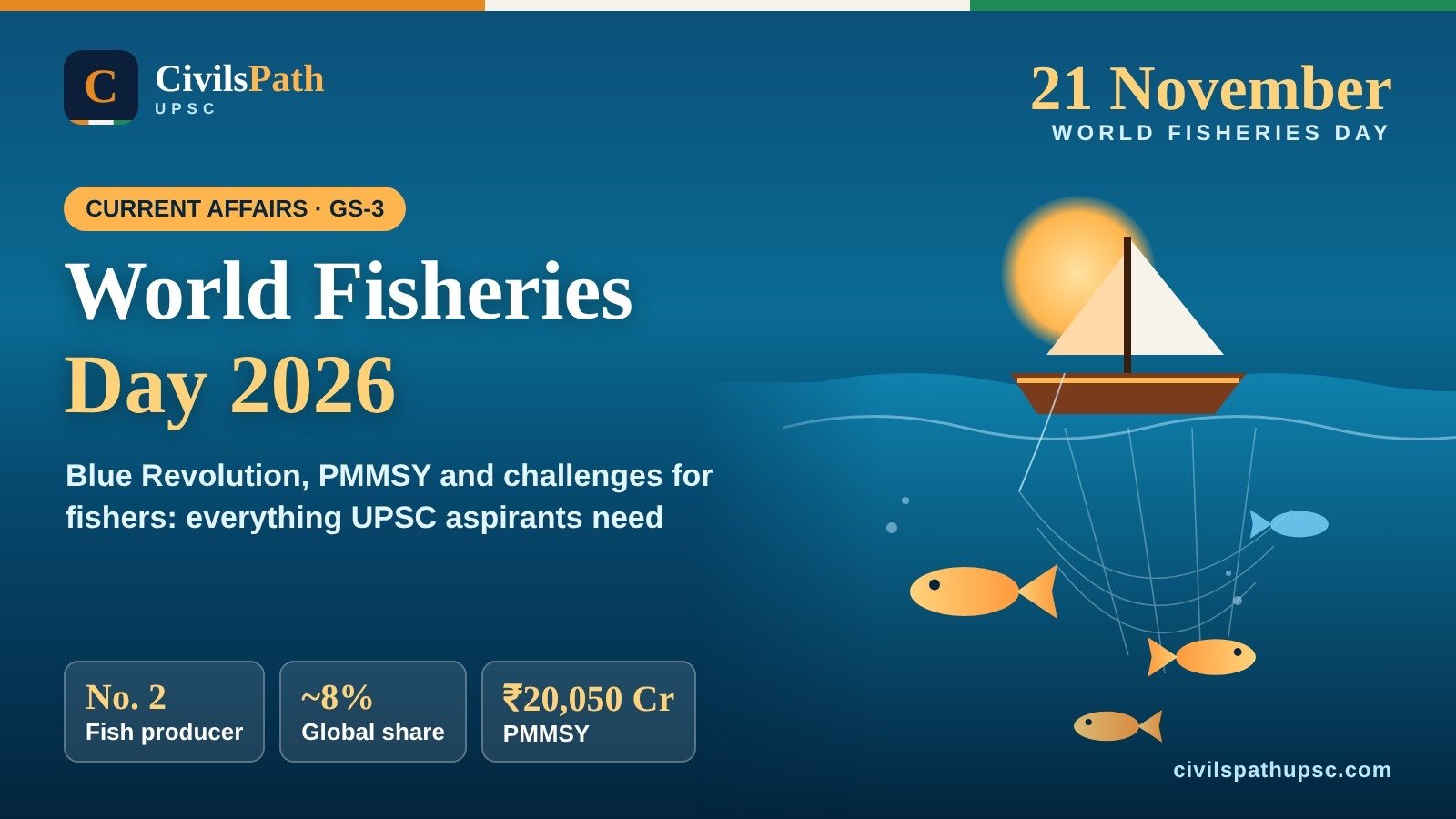
Every year, 21 November is observed as World Fisheries Day. The day recognises the millions of fishers and fish farmers who provide food, nutrition and livelihoods across the world. It is also a reminder that rivers and oceans are not inexhaustible: if they are overexploited, this resource can collapse.
The day has an Indian connection
World Fisheries Day traces its origin to 1997, when organisations representing fishers and fish workers met in New Delhi and formed the World Fisheries Forum. The forum decided to observe 21 November every year to promote sustainable fishing and the rights of fishing communities.
India's fisheries sector at a glance
1. India is the world's second-largest fish producer, with a share of about 8% of global fish production.
2. India is also among the world's leading countries in aquaculture (fish farming in ponds and tanks).
3. The sector supports the livelihoods of about 3 crore people, a large share of them small-scale and traditional fishers.
4. Shrimp makes up the largest share of India's seafood exports.
5. Andhra Pradesh leads in inland fish production.
Key government initiatives
Department of Fisheries: Created in 2019 as a separate department under the Ministry of Fisheries, Animal Husbandry and Dairying.
Pradhan Mantri Matsya Sampada Yojana (PMMSY): Launched in 2020 with a total outlay of ₹20,050 crore. It aims to raise fish production and exports, cut post-harvest losses and increase fishers' incomes. It is seen as the next phase of the Blue Revolution.
Kisan Credit Card (KCC): Extended to fishers and fish farmers for affordable credit.
Fisheries and Aquaculture Infrastructure Development Fund (FIDF): For fishing harbours, cold storage and other infrastructure.
Major challenges
1. Overfishing, which is depleting several species.
2. Marine pollution, plastic waste and the loss of coastal habitats such as mangroves.
3. Climate change: warming seas, cyclones and shifting fish habitats.
4. Post-harvest losses due to weak cold chains and storage.
5. Cross-border fishing disputes, such as in the Palk Strait between India and Sri Lanka, where arrests of fishers recur.
6. Small fishers' limited access to modern boats, insurance and markets.
Why it matters for UPSC
GS-3 (Economy and Agriculture): Allied sector, Blue Economy, PMMSY, exports.
GS-3 (Environment): Sustainable fisheries, marine biodiversity, climate change.
GS-2 (International Relations): India–Sri Lanka fishers' issue, WTO negotiations on fisheries subsidies.
GS-1 (Geography): Distribution of fishing grounds, effect of warm and cold ocean currents on fish production.
Prelims practice question
With reference to the Pradhan Mantri Matsya Sampada Yojana (PMMSY), consider the following statements:
1. The scheme was launched in 2020.
2. It is implemented under the Ministry of Fisheries, Animal Husbandry and Dairying.
3. It promotes only marine fishing and does not cover inland fisheries.
Which of the statements given above are correct?
(a) 1 and 2 only (b) 2 and 3 only (c) 1 and 3 only (d) 1, 2 and 3
Answer: (a). PMMSY covers both marine and inland fisheries.
Mains practice question
"India's fisheries sector has great potential to raise rural incomes, but sustainability is its biggest challenge." Discuss, and suggest measures in the context of the Blue Economy. (250 words)
Conclusion
Fish is not just food. It is the livelihood of crores of families and a major source of nutrition for the country. The Blue Revolution has raised production, but real success will come when output grows while oceans and rivers stay healthy, and small fishers share equally in that growth.
This article is based on public government sources. For the latest figures, see the Department of Fisheries (dof.gov.in).