COP31 ends without a deal: Why the Antalya climate summit collapsed and what it means for India | UPSC Current Affairs
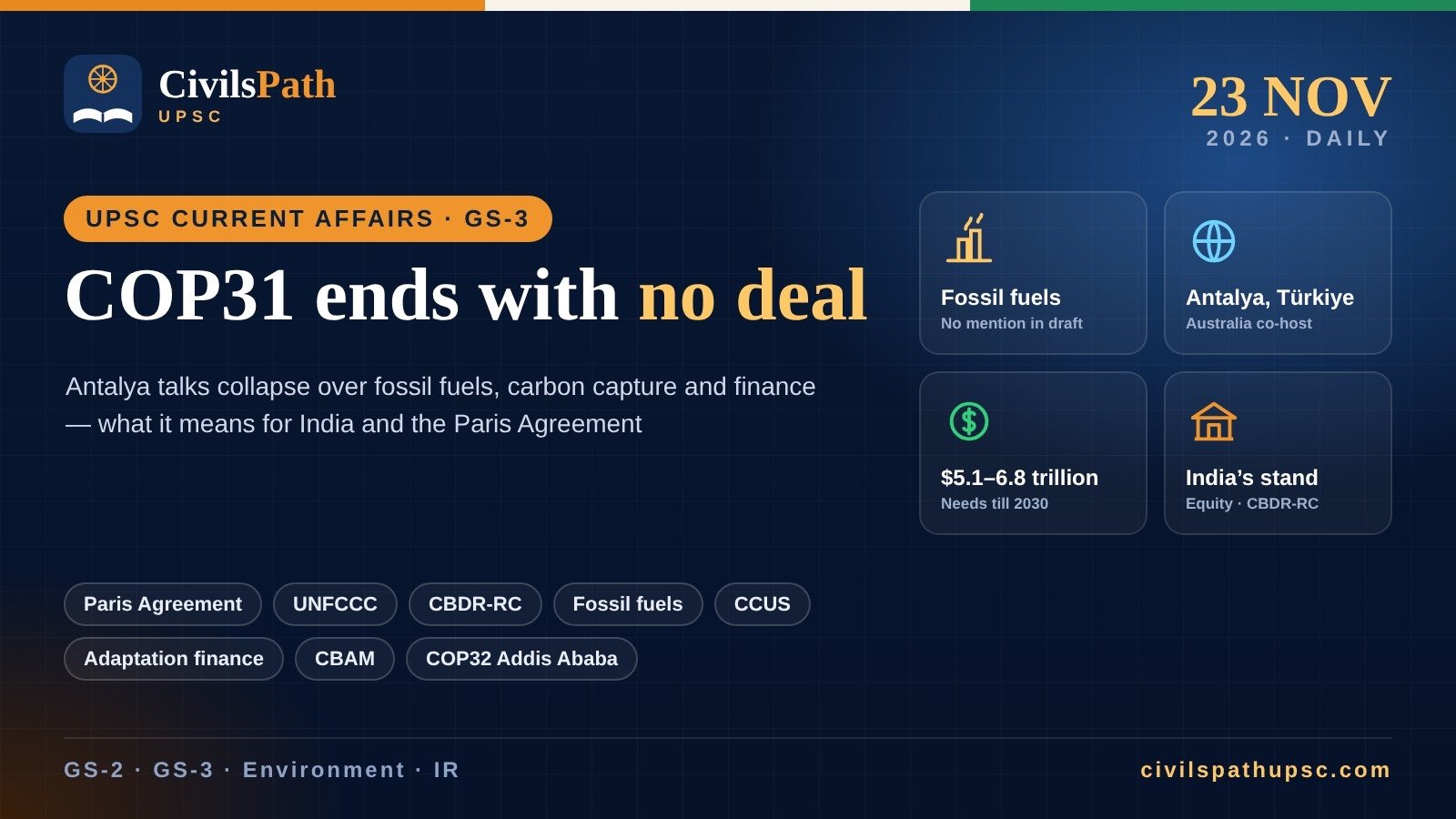
The 31st UN Climate Change Conference (COP31) in Antalya, Türkiye, ended on 22 November 2026 without an overarching agreement. Talks ran more than 44 hours past the scheduled close, and in the end the presidency said there was no consensus and no new text would be offered. Reports call it the first COP since Copenhagen (2009) to end without a cover decision.
What happened at Antalya
Türkiye hosted COP31, with Australia leading the negotiations as co-host. Turkish COP31 President Murat Kurum announced the lack of consensus at the closing plenary. Australia's Chris Bowen, President of Negotiations, called the outcome "very disappointing".
The fight was over the presidency's draft text of 19 November. It did not mention fossil fuels, oil, coal or gas by name. It only referred back to the 2023 Dubai (COP28) outcome, which had called for "transitioning away from fossil fuels".
The four main sticking points
1. Fossil fuels: The EU, Panama, Vanuatu, the Marshall Islands and other vulnerable countries wanted clear language on moving away from fossil fuels. Saudi Arabia, Iran and Russia opposed any such wording.
2. Carbon capture (CCUS): The draft backed industrial carbon capture of at least 500 million tonnes of CO2 a year by 2035. Critics said this would let countries rely on technology instead of cutting emissions.
3. Climate finance: The draft cited developing countries' needs of US$5.1–6.8 trillion till 2030. Its call to "at least triple" adaptation finance by 2035 was criticised for having no clear baseline.
4. Electrification: A presidency push to raise electricity's share of final energy use to 35% by 2035, backed by 70+ countries, was left out of the final text.
India's stand at COP31
India argued that equity, climate justice and Common But Differentiated Responsibilities and Respective Capabilities (CBDR-RC) must guide the talks. It raised the historical responsibility of developed countries for emissions over two centuries.
India called fair access to the remaining carbon budget non-negotiable and opposed unilateral trade measures such as the EU's Carbon Border Adjustment Mechanism (CBAM). It asked developed countries to meet their finance promises and did not join the electrification pledge.
India pointed out that it has about 17% of the world's population but only 4–5% of cumulative global emissions. Environment Minister Bhupender Yadav said India engaged "constructively" till the end and that "the absence of a cover decision does not pause climate action". He noted that India has over 170 GW of solar capacity.
Does this mean the Paris Agreement has failed?
No. The Paris Agreement (2015) stays in force. Countries still have to submit and update their Nationally Determined Contributions (NDCs). The World Resources Institute called COP31 "a failure of political leadership rather than a failure of the Paris Agreement".
Unresolved issues, including fossil fuels and finance, now move to COP32 in Addis Ababa, Ethiopia, in 2027.
Prelims facts
• COP = Conference of the Parties to the UNFCCC (adopted 1992, Rio Earth Summit).
• COP31: Antalya, Türkiye (host); Australia led negotiations. COP32: Addis Ababa, Ethiopia (2027).
• COP28 (Dubai, 2023): first Global Stocktake; call for "transitioning away from fossil fuels".
• COP29 (Baku, 2024): New Collective Quantified Goal (NCQG) on finance.
• COP30: Belém, Brazil (2025).
• COP decisions are taken by consensus, so any one country can block a text.
• CBDR-RC is a principle of the UNFCCC (Article 3) and the Paris Agreement.
• CBAM is an EU carbon border tax on imports such as steel, aluminium and cement.
GS linkage
• GS-3 (Environment): climate change, international climate negotiations, CCUS, energy transition.
• GS-2 (IR): multilateralism, Global South coalitions (BASIC, LMDC), India–EU (CBAM).
• GS-3 (Economy): climate finance, carbon trade measures, renewable energy.
• Essay: "Climate justice and the burden of development".
Mains practice question
"The collapse of COP31 shows the limits of consensus-based climate diplomacy." Critically examine this statement and suggest how India can balance its development needs with global climate goals. (15 marks, 250 words)
This article is based on publicly available information and news reports. Prepared by CivilsPath for UPSC aspirants.