UPSC Syllabus 2027: complete Prelims, Mains (GS 1-4, Essay, Optional) and Interview syllabus explained simply
The single most important document in UPSC preparation is its syllabus. Toppers say it again and again: the syllabus is your map. Without it, you may study a lot, but not in the right direction. In this guide, we explain the complete syllabus of the UPSC Civil Services Examination stage by stage, in simple language, along with how to approach each part.
Note: this is a simplified explanation of the official syllabus. For the exact wording, always check the official UPSC notification at upsc.gov.in every year.
The exam at a glance
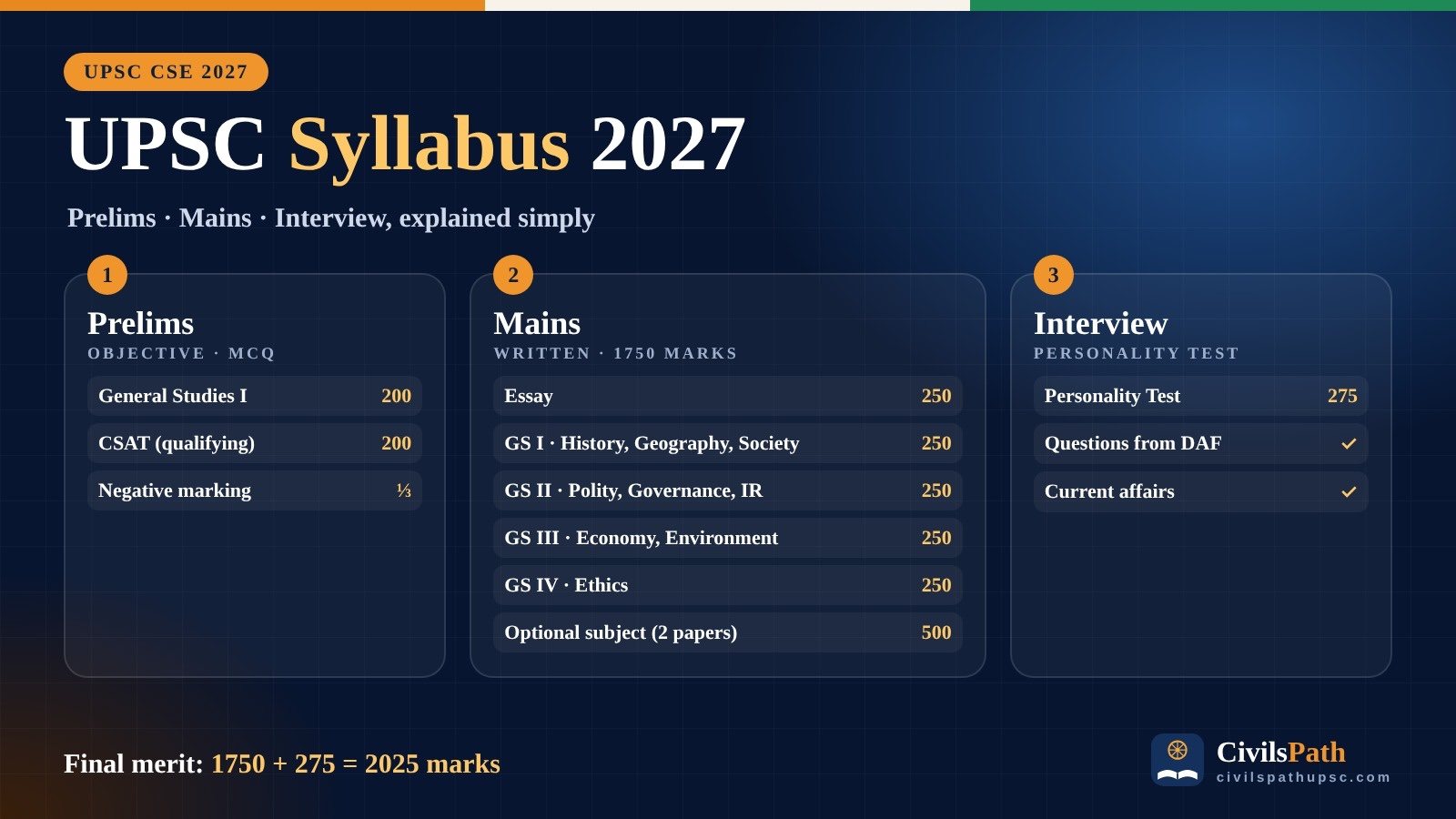
The UPSC Civil Services Examination has three stages: the Preliminary exam (Prelims), the Main exam (Mains) and the Personality Test (Interview). The final merit is based on Mains (1,750 marks) and the Interview (275 marks), a total of 2,025 marks.
1. Preliminary exam (Prelims) syllabus
Prelims has two objective (MCQ) papers of 200 marks each, each two hours long.
General Studies Paper I (100 questions, 200 marks)
This paper decides whether you move to Mains. Its main areas are:
1. Current events of national and international importance.
2. History of India and the Indian National Movement: ancient, medieval and modern history, along with art and culture.
3. Indian and world geography: physical, social and economic geography.
4. Indian polity and governance: the Constitution, political system, Panchayati Raj, public policy and rights issues.
5. Economic and social development: sustainable development, poverty, inclusion, demographics and social sector initiatives.
6. General issues on environment, ecology, biodiversity and climate change.
7. General science.
General Studies Paper II, or CSAT (80 questions, 200 marks)
This paper is only qualifying: you need 33%, or 66 marks. It covers:
1. Comprehension: reading passages and answering questions.
2. Interpersonal skills, including communication skills.
3. Logical reasoning and analytical ability.
4. Decision making and problem solving.
5. General mental ability.
6. Basic numeracy (Class 10 level) and data interpretation (charts, graphs, tables).
Negative marking: in both papers, one-third of the marks for a question are deducted for a wrong answer.
2. Main exam (Mains) syllabus
Mains is a written (descriptive) exam of nine papers, each three hours long.
Qualifying papers (not counted in merit)
Paper A, Indian language (300 marks): any one language from the Eighth Schedule of the Constitution. It includes essay, comprehension, précis writing, vocabulary, grammar and translation.
Paper B, English (300 marks): similar sections.
You need at least 25% in each. If you fail these, your other papers are not evaluated.
Paper I: Essay (250 marks)
You write two essays, one from each of two sections, each about 1,000 to 1,200 words. Topics often come from philosophical statements, society, economy, science and ethics. Marks reward clarity of thought, structure and a balanced view.
Paper II: General Studies I (250 marks)
Indian heritage and culture, history and geography of the world and society. Main topics:
1. Indian culture: art forms, literature and architecture from ancient to modern times.
2. Modern Indian history from the mid-18th century to the present, the freedom struggle and its important personalities.
3. Post-independence consolidation and reorganisation of the country.
4. World history from the 18th century: the industrial revolution, world wars, colonisation and decolonisation, communism and capitalism.
5. Indian society: diversity, role of women and women's organisations, population, poverty, urbanisation, effects of globalisation, social empowerment, communalism, regionalism and secularism.
6. Physical geography: key features of world physical geography, and phenomena such as earthquakes, tsunamis, volcanoes and cyclones.
7. Distribution of resources and factors behind the location of industries.
Paper III: General Studies II (250 marks)
Governance, Constitution, polity, social justice and international relations. Main topics:
1. The Indian Constitution: historical background, evolution, features, amendments and basic structure.
2. Functions of the Union and the States, federal structure and devolution of powers.
3. Parliament and state legislatures, the executive and the judiciary.
4. Constitutional, statutory and quasi-judicial bodies.
5. Government policies, welfare schemes and mechanisms for vulnerable sections.
6. Issues relating to health, education and human resources; poverty and hunger.
7. Transparency and accountability in governance, e-governance, citizens' charters, and the role of civil services in a democracy.
8. International relations: India and its neighbours, bilateral and regional groupings, important international institutions, and the Indian diaspora.
Paper IV: General Studies III (250 marks)
Technology, economic development, biodiversity, environment, security and disaster management. Main topics:
1. Indian economy: planning, mobilisation of resources, growth, employment, inclusive growth and the government budget.
2. Agriculture: cropping patterns, irrigation, farm subsidies, MSP, food processing and land reforms.
3. Effects of liberalisation, infrastructure (energy, ports, roads, railways) and investment models.
4. Science and technology: applications in everyday life, space, computers, robotics, nanotechnology, biotechnology and intellectual property rights.
5. Environment: conservation, pollution and environmental impact assessment.
6. Disaster management.
7. Internal security: extremism, border management, cyber security, money laundering, organised crime and terrorism, security forces and agencies.
Paper V: General Studies IV (250 marks)
Ethics, Integrity and Aptitude. Main topics:
1. Ethics and human values; lessons from great leaders, reformers and administrators; the role of family, society and education.
2. Attitude and foundational values for civil service: impartiality, integrity, non-partisanship, empathy and tolerance.
3. Emotional intelligence.
4. Contributions of moral thinkers and philosophers from India and the world.
5. Ethics in public administration, ethical dilemmas, probity in governance, the right to information and the challenges of corruption.
6. Case studies based on real administrative situations. This is the most important part of the paper.
Papers VI and VII: Optional subject (250 + 250 marks)
Candidates choose one optional subject from UPSC's list of 48 subjects. These include Geography, History, Political Science and International Relations, Public Administration, Sociology, Anthropology, Philosophy, Economics, Law, Mathematics, Physics, Chemistry, Medical Science, and the literature of many languages, including Hindi and English. Each optional has two papers.
3. Personality Test (Interview), 275 marks
The interview has no fixed syllabus. The board assesses whether you are suitable for public service. It looks at mental alertness, critical thinking, clear and logical expression, balance of judgement, variety and depth of interests, leadership and moral integrity. Questions often come from your DAF (Detailed Application Form), such as your education, home district, hobbies and service preferences, along with current affairs.
How to use the syllabus well
1. Print the syllabus and keep it on your study table. Tick each topic as you complete it.
2. Link every topic to previous years' questions (PYQs). They show what UPSC actually asks from that topic.
3. Do not prepare for Prelims and Mains separately. Most of the GS syllabus overlaps, so prepare in an integrated way.
4. Connect current affairs to syllabus topics in your notes, for example "air pollution → GS3 environment".
5. Do not leave GS4 (Ethics) for the end. Practise case studies from the start.
6. Download your optional subject's syllabus separately and make a checklist for it too.
Conclusion
At first glance, the UPSC syllabus looks enormous. But once you break it into parts, it becomes a clear path. The candidate who understands every word of the syllabus studies less but studies right. Download the syllabus today, make it your map, and move forward one ticked topic at a time.
The complete official syllabus is published every year in the Appendix of the UPSC Civil Services Examination notification, available at upsc.gov.in.
This is a simplified explanation of the official UPSC syllabus. For the exact and complete syllabus, always check the official notification at upsc.gov.in every year.