Asia Power Index 2026: India stays Asia's third most powerful country behind US and China | UPSC Current Affairs
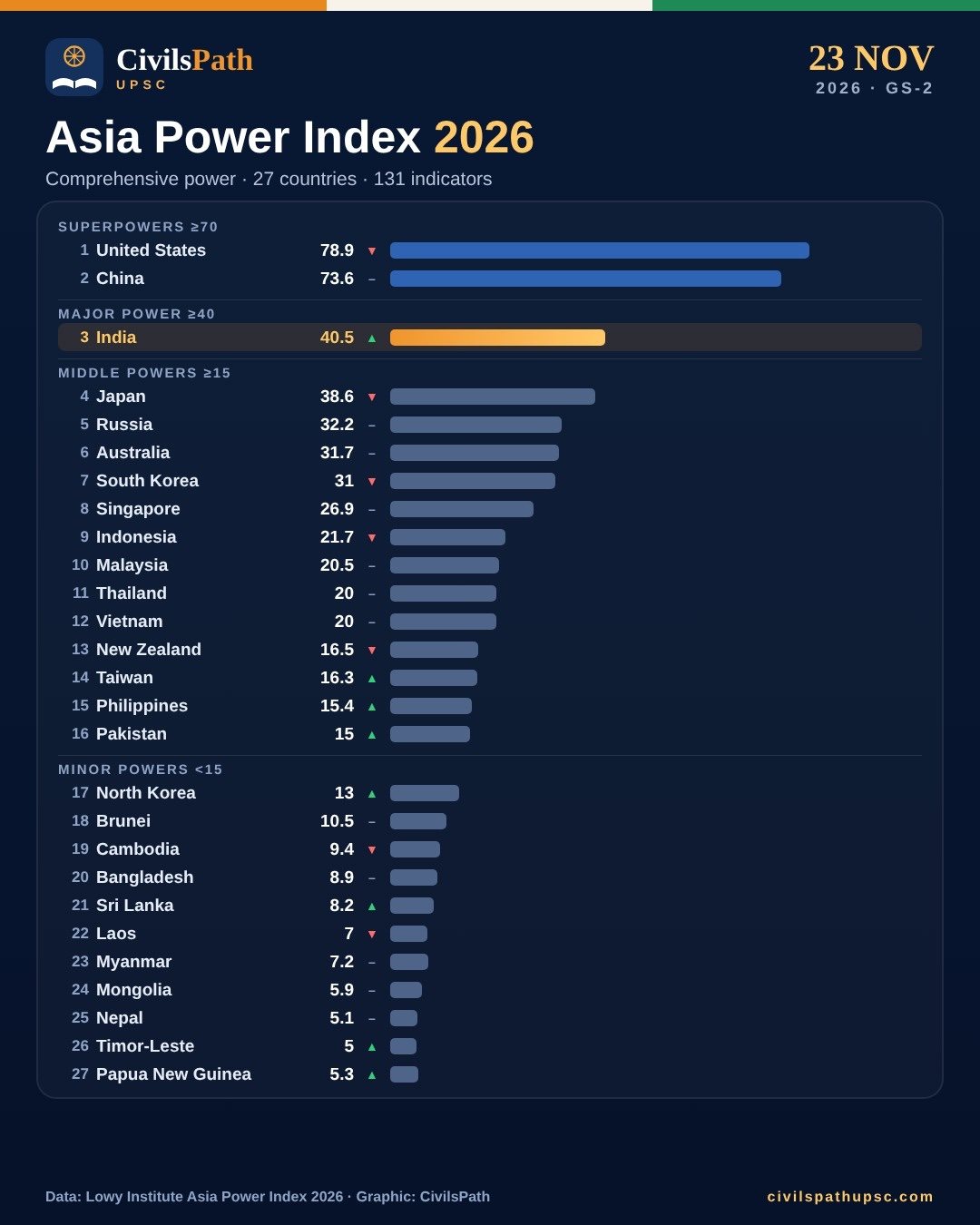
India has kept its place as Asia's third most powerful country in the Lowy Institute's Asia Power Index 2026. With a score of 40.5 out of 100, India stays in the "major power" category, behind only the United States (78.9) and China (73.6). Japan (38.6) is fourth and Russia (32.2) fifth.
What is the Asia Power Index?
The Asia Power Index is published every year since 2018 by the Lowy Institute, a think tank based in Sydney, Australia. It ranks 27 countries and territories in Asia using 131 indicators. The 2026 edition is the eighth.
Power is measured in two parts. Resources are what a country has, and influence is how well it uses them.
Resources (4 measures): Economic capability, Military capability, Resilience, Future resources.
Influence (4 measures): Economic relationships, Defence networks, Diplomatic influence, Cultural influence.
Countries are grouped by score: Superpowers (70 points or more), Major powers (40 or more), Middle powers (15 or more), Minor powers (below 15).
Key findings of 2026
1. The United States (78.9) is still number one, but its score has slipped. The gap between the US and China is the smallest since the index began in 2018.
2. China (73.6) is second, with its diplomatic influence at record levels.
3. India (40.5) is third and the only "major power". Its score rose by 0.5 points from 2025.
4. Japan (38.6) remains the top middle power, but India continues to pull ahead of it.
5. Pakistan (15.0) moved into the middle-power group at 16th. North Korea (13.0) is 17th.
6. Among India's neighbours, Bangladesh (8.9), Sri Lanka (8.2), Myanmar (7.2) and Nepal (5.1) are minor powers.
Where India stands
Gains in 2026: India improved on military capability, defence networks, future resources and cultural influence.
Strengths: India ranks 4th in military capability (score 48.5) and 4th in diplomatic influence (70.3). It is 3rd in economic size (GDP).
Weaknesses: India is only 11th in technology and 9th in defence networks (18.6). Its economic capability score fell this year.
China gap: The India–China gap is the narrowest since 2018, but China's overall power is still about 80% higher than India's.
What is the "power gap"?
The power gap compares a country's actual influence with what its resources would predict. A positive gap means a country punches above its weight. India's power gap is negative (about −3.3), which means its influence in Asia is lower than its size and resources suggest. Weak trade links with the region and limited defence partnerships are the main reasons.
Why this matters for India
India has the size, population and military to be a major power, but it must turn these resources into influence. That means deeper trade integration with Southeast and East Asia, stronger defence partnerships (Quad, ASEAN, Indian Ocean states), more investment in technology and R&D, and better connectivity projects under the Act East Policy.
Prelims facts
• Asia Power Index: published by the Lowy Institute (Sydney, Australia), started 2018.
• 27 countries/territories, 131 indicators, 8 measures.
• 2026 top 5: US (78.9), China (73.6), India (40.5), Japan (38.6), Russia (32.2).
• Superpower ≥ 70 points; Major power ≥ 40; Middle power ≥ 15; Minor power < 15.
• India: "major power", 4th in military capability and diplomatic influence.
• Power gap: actual influence minus expected influence from resources (India: negative).
GS linkage
• GS-2 (IR): India's rise, Indo-Pacific, India–China rivalry, Act East Policy, Quad.
• GS-3 (Security & Economy): military modernisation, defence exports, technology and R&D.
• Essay: "Power is not what a nation has, but what it can do with it."
Mains practice question
"India has the resources of a major power but not yet the influence of one." In the light of the Asia Power Index 2026, discuss the factors behind India's negative power gap and suggest measures to convert capability into regional influence. (15 marks, 250 words)
This article is based on publicly available information and the Lowy Institute's published data. Prepared by CivilsPath for UPSC aspirants.