How to become an IAS officer: complete guide from Class 12 to LBSNAA (eligibility, exam, books, strategy, salary)
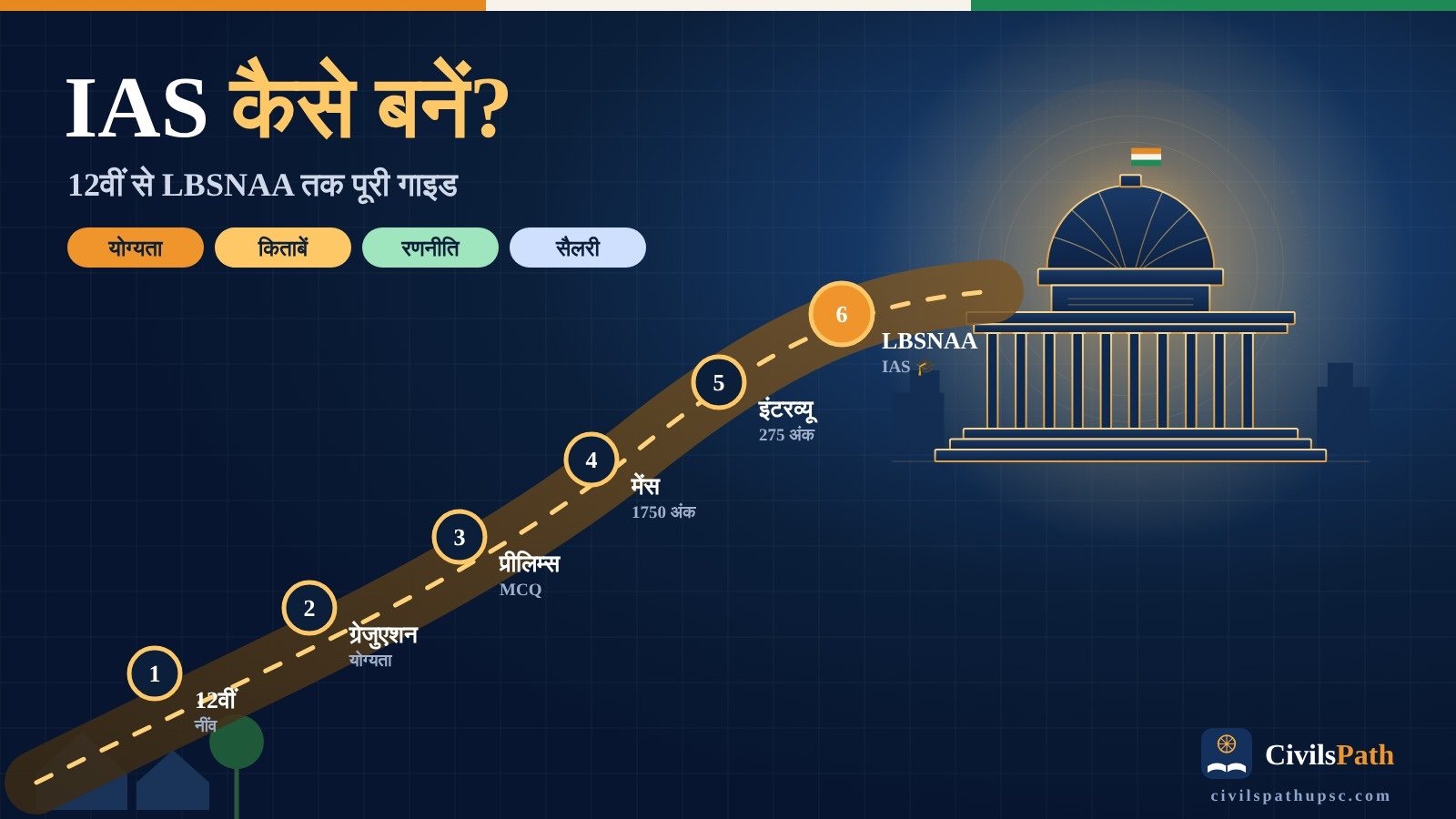
"I want to become an IAS officer." Lakhs of young Indians say this to themselves every year. Some are inspired by an honest officer they saw in their district, some want to fix the problems around them, and some want to fulfil a family dream. But the first question is always the same: how exactly do you become an IAS officer? Which exam do you take, when should you start, which books should you read and how long does it take? This guide answers every one of these questions, from the beginning to the end.
What is the IAS?
The IAS, or Indian Administrative Service, is the country's most prestigious All India Service. IAS officers run entire districts as District Magistrates or Collectors, and later rise to posts such as Secretary and Chief Secretary in state governments, and Joint Secretary, Secretary and Cabinet Secretary at the Centre. From framing government policy to implementing it on the ground, IAS officers play a central role at every level.
Which exam do you need to clear?
To become an IAS officer, you need to clear the Civil Services Examination (CSE) conducted by the Union Public Service Commission (UPSC). This single exam recruits for more than 20 services, including the IAS, IPS, IFS (Indian Foreign Service) and IRS. Services are allotted on the basis of your final rank and preferences, and the IAS usually goes to candidates with high ranks.
Eligibility
Educational qualification: A graduation degree in any subject from a recognised university. Arts, science, commerce, engineering, medicine, any stream works. Final-year students can also appear for the Preliminary exam.
Age limit: Minimum 21 and maximum 32 years on 1 August of the exam year for General and EWS candidates. OBC candidates get relaxation up to 35 years, SC/ST up to 37 years, and Persons with Benchmark Disability get an additional 10 years.
Number of attempts: 6 for General and EWS, 9 for OBC, and unlimited (within the age limit) for SC/ST. Appearing in even one paper of the Preliminary exam counts as an attempt.
Nationality: You must be a citizen of India to join the IAS.
What to do after Class 12
You cannot take the UPSC exam directly after Class 12, because graduation is required. But this is the time to build your foundation, not to waste it:
1. Choose your graduation subject carefully. Pick a subject you enjoy. History, political science, geography, sociology and public administration are useful for UPSC later, but engineers and doctors also top the exam every year.
2. Build a daily newspaper habit: The Hindu, The Indian Express or a good Hindi newspaper.
3. Start reading NCERT textbooks from Class 6 to 12, slowly and steadily.
4. Work on your writing and speaking. Take part in essays, debates and group discussions.
5. Serious preparation can begin in the second or third year of graduation.
The three stages of the exam
The UPSC Civil Services Examination is held in three stages:
1. Preliminary exam (Prelims): objective (MCQ), usually in May or June. There are two papers: General Studies Paper I (200 marks, 100 questions) and CSAT, Paper II (200 marks, 80 questions). CSAT is only qualifying, and you need 33% (66 marks) in it. The merit is based only on GS Paper I. One-third of the marks are deducted for each wrong answer.
2. Main exam (Mains): written (descriptive), usually in August or September. There are 9 papers in all. Two language papers (one Indian language and English, 300 marks each) are only qualifying. The seven papers counted for merit are the Essay (250), General Studies I, II, III and IV (250 each) and two Optional Subject papers (250 each), for a total of 1,750 marks.
3. Personality Test (Interview): 275 marks, held at Dholpur House in New Delhi.
Final merit: 1,750 + 275 = 2,025 marks. Prelims marks are not added to the final merit.
Can you become an IAS officer through the Hindi medium?
Absolutely. The Main exam and the Interview can both be taken in Hindi or in any language listed in the Eighth Schedule of the Constitution. Hindi-medium candidates are selected every year. What matters is good books, clear writing and regular answer-writing practice.
Which books should you read? (basic booklist)
Foundation: NCERT textbooks from Class 6 to 12 (history, geography, polity, economics, science).
Polity: Indian Polity by M. Laxmikanth.
Modern Indian history: Spectrum's A Brief History of Modern India, or Bipan Chandra's old NCERT.
Geography: NCERTs plus Certificate Physical and Human Geography by G.C. Leong, and a good atlas.
Economy: NCERTs followed by a standard book such as Ramesh Singh's, along with summaries of the Economic Survey and the Union Budget.
Environment: NCERT biology chapters on ecology and one standard book.
Current affairs: a daily newspaper, PIB and one monthly compilation.
Remember: fewer books, more revisions. Reading one book five times is better than reading five books once.
Preparation strategy, step by step
1. Make the syllabus your map. Print the official UPSC syllabus and keep it with you.
2. Study previous years' question papers (PYQs). They show what UPSC actually asks and how.
3. Choose your optional subject early, based on interest and available material, not rumours.
4. Start answer writing from day one. Mains is a writing exam.
5. Keep your notes short, so that you can revise quickly in the final months.
6. Take at least 30 to 40 mock tests before Prelims, and do not take CSAT lightly.
7. Make a daily timetable, but do not burn yourself out. Six to eight hours of steady, focused study is enough.
Is coaching necessary?
No. Coaching can help, but it is not compulsory. Free government sources (NCERT, PIB, PRS, the Economic Survey), good books and online test series are easily available today. Every year, many candidates clear the exam studying at home without coaching. The real difference comes from discipline, the right sources and consistent practice.
How long does it take?
The full process, from the notification (usually January or February) to the final result (April or May), takes about a year. Preparation usually needs 12 to 18 months of serious study. Most successful candidates clear the exam in more than one attempt, so patience is your biggest weapon.
After selection: from LBSNAA to the district
Selected IAS officers train at the Lal Bahadur Shastri National Academy of Administration (LBSNAA), Mussoorie. Training begins with a Foundation Course along with other services, followed by IAS-specific training and district training in the allotted state. Officers then usually begin their field career as Sub-Divisional Magistrates (SDM), and a few years later become District Magistrates (DM).
What is the salary of an IAS officer?
Under the 7th Pay Commission, an IAS officer's starting basic pay is ₹56,100 per month (Level 10). On top of this come dearness allowance, house rent allowance or government accommodation, a vehicle and other facilities. At the level of Cabinet Secretary, the basic pay reaches ₹2,50,000 per month. But most officers say the real reward of the service is not the salary, it is the chance to change people's lives.
Common mistakes to avoid
Hoarding too many books and PDFs. Ignoring the syllabus and PYQs. Postponing answer writing till the end. Taking CSAT lightly. Spending hours on social media and Telegram. And the biggest mistake of all: losing faith in yourself after one or two failures.
Conclusion
Becoming an IAS officer is hard, but not impossible. This exam does not care about your college, your city or your family background. It only looks at how honestly, patiently and smartly you have prepared. Download the syllabus today, open your first NCERT and take the first step. Every long journey begins with a single step.
Exam rules, dates and vacancies are announced afresh every year, so always check the latest official notification at upsc.gov.in before applying.
Eligibility, age limits and exam rules can change every year in the UPSC notification. Always check the official notification at upsc.gov.in before applying.