From library to labyrinth: how Telegram turned from a UPSC aspirant's best friend into a trap
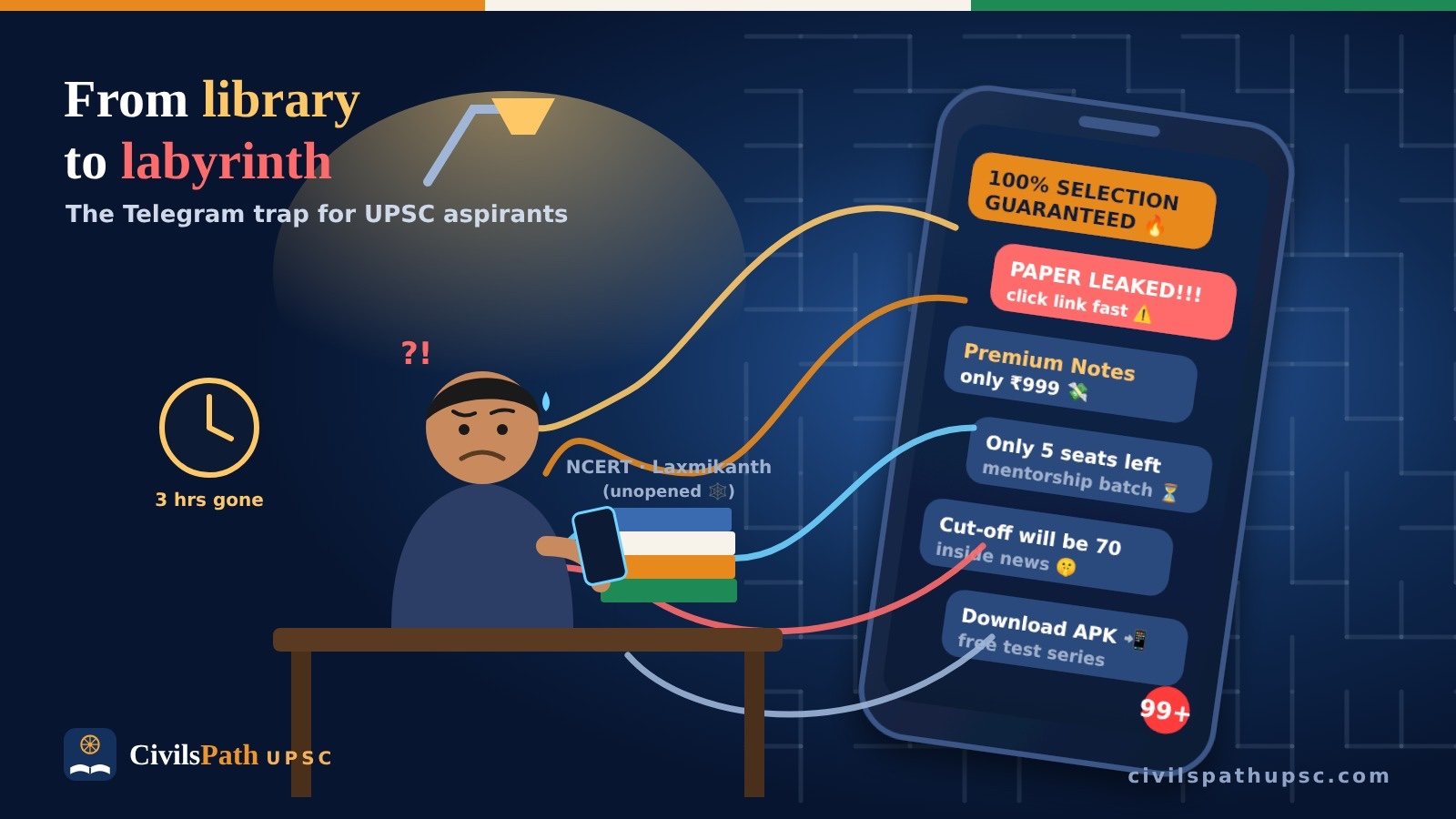
There was a time when Telegram felt like a small miracle for UPSC aspirants.
A student in a rented room in Mukherjee Nagar and a student in a village in Bihar, with no coaching centre within a hundred kilometres, could suddenly read the same notes, solve the same tests and follow the same daily current affairs. Newspapers, government reports, toppers' answer copies, previous years' papers: everything was a tap away, often free. For many first-generation aspirants who could not afford Delhi, Telegram was not just an app. It was a library, a study group and a mentor rolled into one.
Somewhere along the way, that library became a labyrinth.
Today, the same app that once levelled the field is full of fake "toppers", paid "guaranteed selection" programmes, leaked-paper rumours, recycled notes sold as premium material, and an endless stream of messages designed to make you anxious, not prepared. Thousands of aspirants wake up, open Telegram "for five minutes", and close it two hours later having studied nothing.
This is not an article against Telegram. We run a Telegram channel too. This is an honest look at how a tool built for learning slowly turned into a trap, and how you can use it without getting caught.
How the dream began
Telegram's rise among aspirants was not an accident. It allowed very large channels, large file uploads, and anonymous broadcasting without sharing phone numbers. Content could be searched and forwarded easily. For a community obsessed with notes, PDFs and daily updates, it was a perfect fit.
In the early years, most channels were run by aspirants themselves. Someone who cleared Prelims would share their notes. Someone else would compile The Hindu editorials every morning. Senior aspirants answered questions late into the night. The culture was simple: help each other, because everyone is fighting the same battle.
Then the numbers grew. And where there are lakhs of anxious young people, there is money to be made.
The anatomy of the trap
The problems on Telegram today are not one big scam. They are a mix of different traps, each feeding on a specific fear of the UPSC aspirant.
1. The "guaranteed selection" economy
The most common trap is the promise of certainty in an exam that is defined by uncertainty. "Join our programme and clear Prelims." "Only 20 seats left in our mentorship batch." "Personal guidance by an officer." Channels display screenshots of high scores, thank-you messages and rank lists, often impossible to verify.
UPSC selects roughly a thousand candidates a year out of lakhs of applicants. No programme on earth can guarantee selection. Anyone who promises it is not selling preparation. They are selling hope, at a price.
2. Fake toppers and borrowed success
A favourite marketing trick is to claim a topper as "our student". After every result, multiple channels and institutes often claim the same successful candidates, sometimes because the candidate took a single free test or attended one webinar. Some channels go further and run under the name or photo of an officer who has no link with them at all.
Aspirants trust these channels because they believe they are learning from someone who has "been there". Often, they are learning from someone who has only been on Telegram.
3. Old notes in new packaging
Many "premium" notes sold through Telegram are nothing but free material from government websites, NCERTs, PIB releases and newspapers, rearranged with a new cover page. Some are outright pirated copies of books and coaching material.
Piracy hurts more than the publisher. Pirated PDFs are often outdated, missing pages or carrying errors, and an aspirant who relies on them may be studying a version of the syllabus that no longer exists. Courts have also taken notice: in 2022, the Delhi High Court directed Telegram to disclose details of channels allegedly sharing an educator's copyrighted material, a sign that piracy on the platform is a legal issue, not just an ethical one.
4. Leaks, rumours and panic
Every year before Prelims and Mains, the same kind of messages appear: "paper leaked", "cut-off will be 70", "UPSC changing pattern next year", "inside news from Dholpur House". Most of them are false. Some are designed to sell a "last-minute crash course". Others simply chase views and followers.
For an aspirant who has given years to this exam, such rumours can be devastating. They create panic, disturb revision and sometimes push candidates to change strategy in the final weeks. The only reliable source of information about the exam is UPSC's official website. Everything else is commentary at best and manipulation at worst.
5. Plain old fraud
Then there are the scams that have nothing to do with studies but target aspirants because they are young, stressed and often away from home: fake scholarship forms that ask for bank details, "government job" offers that demand a registration fee, task-based "earn from home" schemes, investment and trading tips, and APK files that claim to be test series apps but install malware.
An aspirant who would never share an OTP with a stranger on the phone will sometimes click a link on Telegram because it came from a channel with two lakh subscribers. Big numbers create false trust.
6. The misinformation machine
Not all misinformation is malicious. Much of it comes from speed. Channels compete to be the first to post the "daily current affairs PDF", and in that hurry, facts get distorted, numbers are copied wrongly and context is lost. A wrong figure forwarded across fifty channels becomes "common knowledge".
In an exam where a single wrong option costs negative marks, preparing from unverified material is not a small risk. It is a direct one.
Why aspirants keep falling for it
It is easy to blame aspirants for being "naive". That is unfair. The trap works because it is designed around very real pressures.
Fear of missing out: When everyone around you seems to be in some "special" group, you feel left behind if you are not.
Information anxiety: UPSC's syllabus is vast. The feeling that "one more PDF" will close the gap is powerful, even when you have not finished the books you already have.
Loneliness: Many aspirants live alone in small rooms for years. Telegram groups feel like company. Leaving them feels like losing friends.
The illusion of productivity: Downloading, forwarding and saving notes feels like studying. It isn't. A phone full of PDFs and a mind empty of revision is the most common story of a failed attempt.
Hope: After two or three failed attempts, an aspirant becomes vulnerable. Anyone promising a shortcut sounds convincing.
The hidden cost: time
The biggest scam on Telegram is not financial. It is the theft of time.
Imagine an aspirant who spends two hours a day scrolling through channels, downloading material and reading group arguments. Over one year, that is more than 700 hours, roughly the time needed to complete an entire optional subject or revise the whole GS syllabus several times.
UPSC does not reward the person with the most material. It rewards the person who has read limited sources many times, practised answer writing, and stayed calm. Telegram, used without discipline, does the exact opposite: unlimited sources, little revision and constant anxiety.
How to use Telegram without getting trapped
Telegram is still a useful tool. A knife can cut vegetables or cut your finger. The difference is how you hold it. Here is a practical checklist.
1. Keep a hard limit. Follow no more than three to five channels, and only those that consistently give accurate, well-sourced content. Leave the rest without guilt.
2. Fix a time window. Open Telegram once or twice a day at fixed times, for example 20 minutes after lunch. Turn off notifications for everything else.
3. Treat UPSC's website as the only truth. Exam dates, notifications, results, answer keys, cut-offs and rule changes come from upsc.gov.in. Any "inside news" is noise.
4. Verify before you believe. If a channel shares a fact, check it with the original source: PIB, the ministry's website, the official report or a reliable newspaper. Good channels will tell you the source themselves.
5. Never pay for a promise. Pay, if you must, for a clearly defined service such as a test series with known questions and evaluation. Never pay for a "guarantee", a "leak" or "inside information".
6. Never share personal data. No bank details, OTPs, Aadhaar copies or passwords, no matter how official the channel looks. Do not install apps from APK files shared in groups.
7. Respect copyright. Buy the books you use, or use free, legitimate sources such as NCERT, PIB, PRS and government reports. Pirated PDFs are often outdated and incomplete.
8. Watch your mind. If a channel makes you feel anxious, inadequate or panicked every day, it is not helping you prepare. Mute it.
9. Report fraud. If you are cheated, report it at the National Cyber Crime Reporting Portal (cybercrime.gov.in) or call the helpline 1930, and report the channel on Telegram.
A note to channel owners, including us
Those who run channels for aspirants carry a responsibility. Every post reaches thousands of people who trust it with their most precious resource: time. That trust should be repaid with accuracy, sources, honesty about what we know and don't know, and a clear line between education and advertisement.
At CivilsPath, we try to write in our own words, cite our sources and correct our mistakes openly. If we ever fall short, we want our readers to call us out.
Conclusion: the platform did not change, the incentives did
Telegram did not suddenly become evil. What changed is that the attention of lakhs of anxious aspirants became a market. And wherever attention becomes a market, someone will try to sell fear, shortcuts and illusions.
The good news is that the antidote is simple, even if it is not easy: fewer sources, more revision, official information, honest mentors and a phone that serves your preparation instead of controlling it.
The UPSC exam has always rewarded the same qualities: patience, clarity and discipline. No channel can sell you those. But no channel can take them away from you either, unless you let it.
This is an opinion and analysis piece by CivilsPath based on common experiences shared by aspirants. It does not refer to any specific channel, institute or individual.