India hosts 62nd International Coconut Community session in Kochi: key facts for UPSC
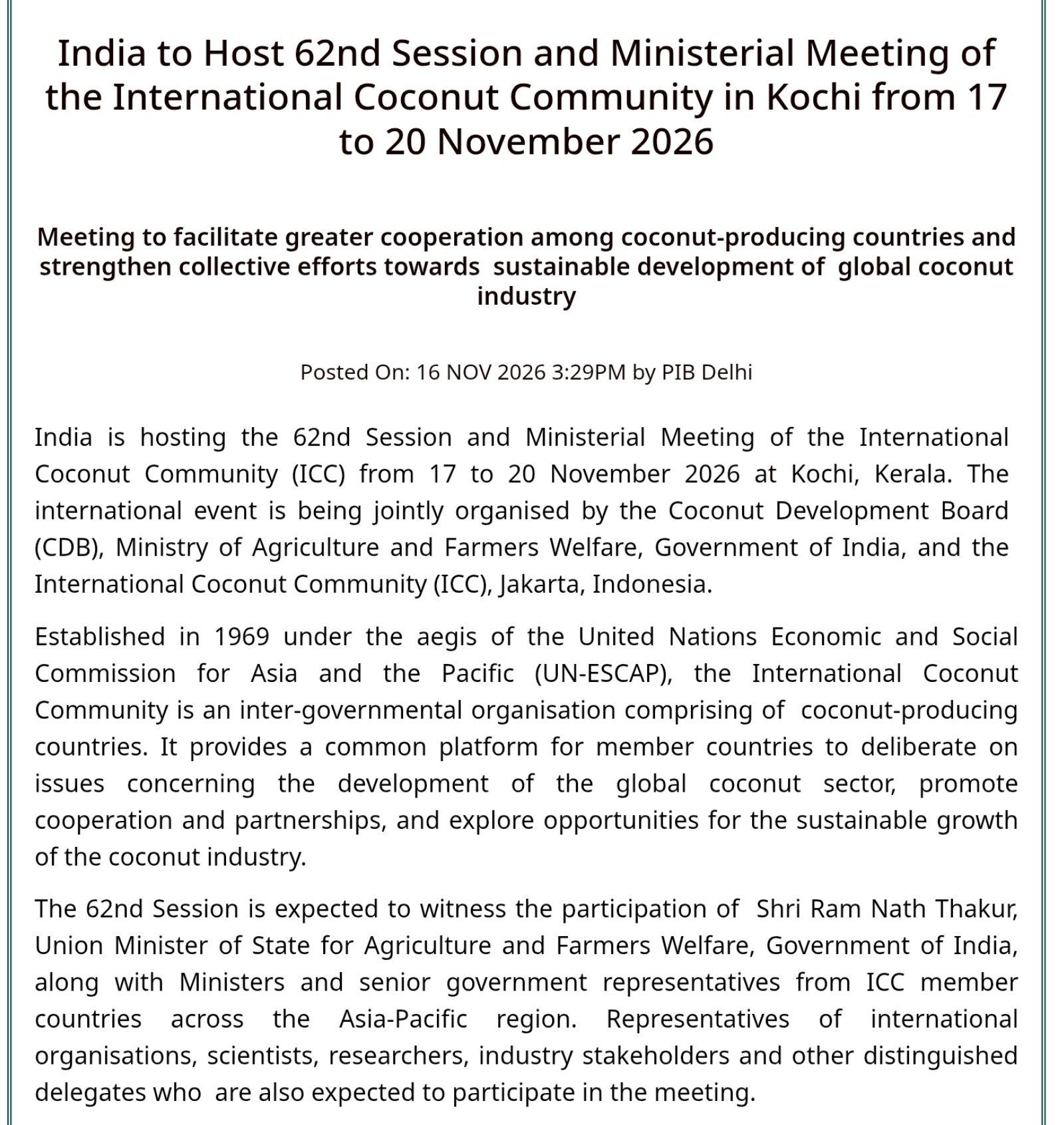
India is hosting the 62nd Session and Ministerial Meeting of the International Coconut Community (ICC) from 17 to 20 November 2026 at Kochi, Kerala. The four-day international event is being jointly organised by the Coconut Development Board (CDB), under the Ministry of Agriculture and Farmers Welfare, Government of India, and the International Coconut Community, headquartered in Jakarta, Indonesia. According to the Press Information Bureau (PIB), the meeting aims to facilitate greater cooperation among coconut-producing countries and to strengthen collective efforts towards the sustainable development of the global coconut industry.
Why in news
The session brings together ministers and senior government representatives from ICC member countries across the Asia-Pacific region, along with representatives of international organisations, scientists, researchers and industry stakeholders. It was inaugurated by Ram Nath Thakur, Union Minister of State for Agriculture and Farmers Welfare, while Union Agriculture Secretary Atish Chandra presided over the inaugural session. Ministers and representatives from Pacific island nations such as the Marshall Islands, Kiribati and Samoa also addressed the gathering.
What is the International Coconut Community?
The International Coconut Community is an inter-governmental organisation of coconut-producing countries. It was established in 1969 under the aegis of the United Nations Economic and Social Commission for Asia and the Pacific (UN-ESCAP). Its headquarters is in Jakarta, Indonesia, and it was earlier known as the Asian and Pacific Coconut Community (APCC). India is a founding member.
The ICC provides a common platform for member countries to discuss issues concerning the development of the global coconut sector, promote cooperation and partnerships, and explore opportunities for the sustainable growth of the coconut industry. World Coconut Day is observed every year on 2 September to mark the foundation day of the organisation.
Key highlights of the 62nd session
Global cooperation: India called for closer cooperation among producing countries in research, technology sharing, climate-resilient farming, farmer empowerment, skill development, value addition and market access.
Changing markets: The Agriculture Secretary said the industry must respond to changing consumer preferences, including growing demand for sustainably produced, vegan and lactose-free products such as coconut milk and plant-based alternatives. He stressed food safety, quality standards, certification and innovation.
Scale in India: As reported from the inaugural session, India's coconut sector supports about 3 crore (30 million) people, including nearly 1 crore (10 million) farmers.
Awards: The ICC presented Plaques of Appreciation in three categories: Best National Coconut Farmer, Outstanding Coconut Scientist/Researcher and Best National Coconut Entrepreneur. Indian awardees included K. Sampathkumar, a coconut farmer from Coimbatore, Apex Coco Products Limited, and M.R. Manikantan, a scientist at ICAR-Central Plantation Crops Research Institute.
Coconut Development Board (CDB)
The Coconut Development Board is a statutory body set up under the Coconut Development Board Act, 1979, and functioning under the Ministry of Agriculture and Farmers Welfare. It came into existence in 1981 and is headquartered in Kochi, Kerala. It is responsible for the integrated development of coconut cultivation and coconut-based industries in India, including productivity improvement, product diversification, market promotion and support to farmers. The Board also maintains Demonstration-cum-Seed Production farms in different parts of the country.
Coconut in India: static facts for Prelims
1. Coconut is called "Kalpavriksha", the tree of life, because almost every part of the palm is useful: food, oil, fibre (coir), timber and fuel.
2. India is one of the world's largest coconut producers, along with Indonesia and the Philippines.
3. Major coconut-producing states are Kerala, Karnataka, Tamil Nadu and Andhra Pradesh. Production is concentrated in the southern and coastal regions.
4. Coconut grows best in a humid tropical climate with well-distributed rainfall and well-drained soils, and is mainly cultivated in coastal and deltaic areas.
5. The coconut palm is monoecious, which means male and female flowers are produced on the same inflorescence.
6. As a monocot, the coconut palm has no vascular cambium, so its trunk does not thicken through secondary growth like many broad-leaved trees.
7. The Government of India announces a Minimum Support Price (MSP) for copra (milling copra and ball copra), the dried kernel of coconut.
8. ICAR-Central Plantation Crops Research Institute (CPCRI), Kasaragod, Kerala, is the main research institute for coconut and other plantation crops.
9. Coir, made from coconut husk fibre, is a major traditional industry in Kerala, and India is a leading producer and exporter of coir products.
Mains angle (GS-3: Agriculture)
Livelihood security: Coconut is largely a smallholder crop. Low and fluctuating prices, ageing palms, pests and diseases (such as root wilt in Kerala) and rising input costs affect farmer incomes.
Climate change: Being a coastal crop, coconut is vulnerable to cyclones, erratic rainfall, drought and salinity intrusion. Climate-resilient varieties and better water management are needed.
Value addition: Most of India's coconut is still sold as raw nuts or copra. Products such as virgin coconut oil, coconut milk, desiccated coconut, coconut sugar, activated carbon and coir products can raise farmer incomes and exports.
International cooperation: Platforms such as the ICC help countries share research, set quality standards and coordinate on markets, which matters for a crop traded globally.
Mains practice question
"Value addition, not just production, holds the key to improving the incomes of plantation crop farmers in India." Discuss with reference to the coconut sector. (15 marks, 250 words)
Prelims practice question
With reference to the International Coconut Community (ICC), consider the following statements:
1. It was established under the aegis of UN-ESCAP.
2. Its headquarters is located in Kochi, India.
3. World Coconut Day is observed on 2 September.
Which of the statements given above is/are correct?
(a) 1 and 2 only (b) 1 and 3 only (c) 2 and 3 only (d) 1, 2 and 3
Answer: (b). The ICC is headquartered in Jakarta, Indonesia. Kochi is the headquarters of India's Coconut Development Board.
Conclusion
By hosting the 62nd ICC session, India has placed itself at the centre of global discussions on the future of the coconut sector. For a crop that supports crores of people, mostly small farmers in coastal states, cooperation on research, climate resilience, quality standards and value addition can make a real difference. For UPSC aspirants, the event connects current affairs with static topics in agriculture, economic geography and international organisations.
This article is based on the PIB release dated 16 November 2026 and publicly available news reports.