India the lone gainer as $1.1 trillion is wiped out of Asian markets: what happened and why it matters for UPSC
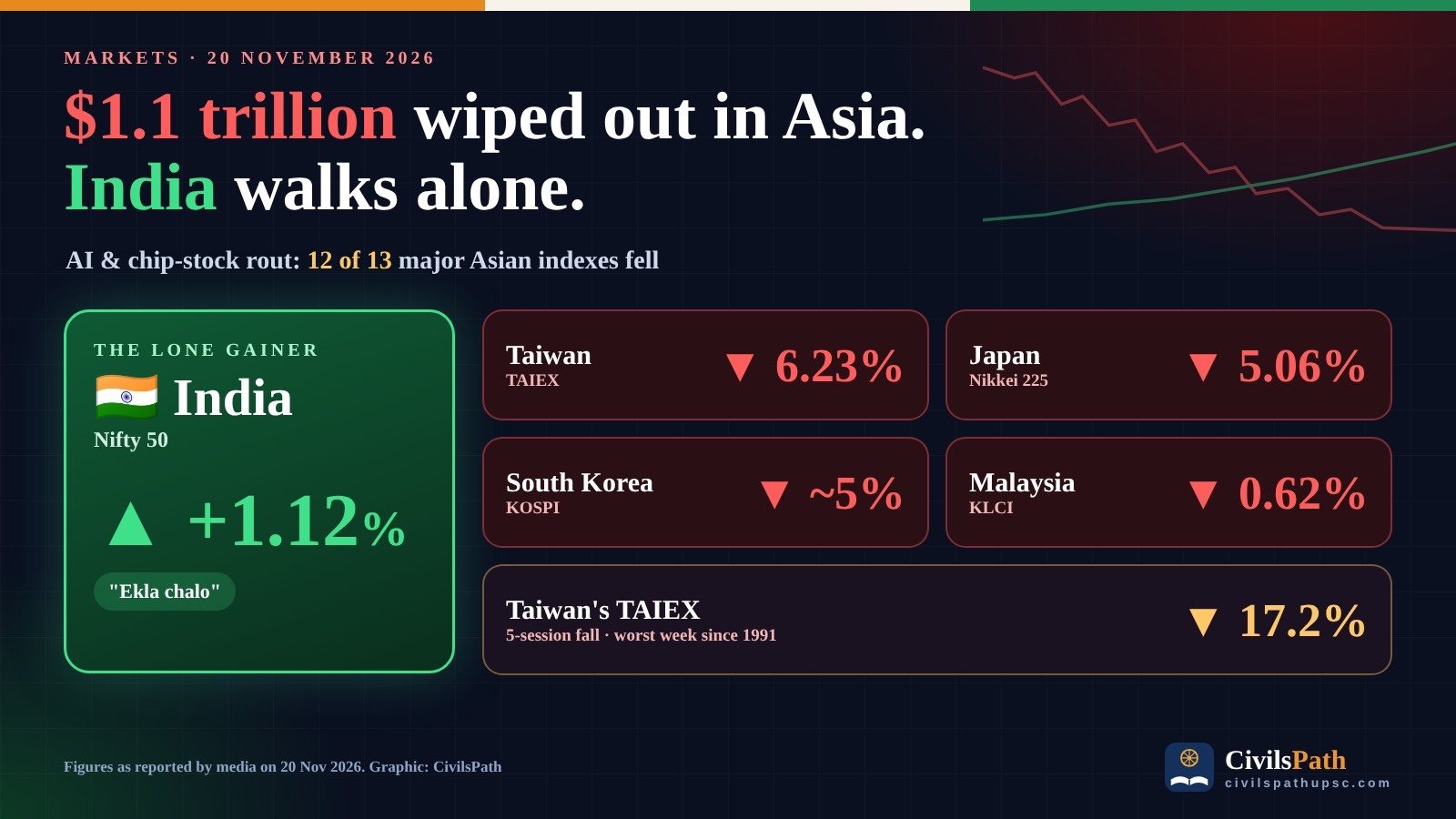
On Friday, 20 November 2026, Asian stock markets went through one of their worst days in years. More than $1.1 trillion in market value was erased in a single session, and 12 of 13 major Asian indexes ended in the red. Amid this sell-off, one market stood apart: India. The Nifty 50 closed 1.12% higher, making India the only major Asian market to end the day with gains.
What happened
The sell-off was led by artificial intelligence (AI) and semiconductor stocks, which had driven much of Asia's rally over the past two years. Reported moves on Friday included:
1. Taiwan's TAIEX fell 6.23%, and lost about 17.2% over five sessions, its worst week since 1991.
2. Japan's Nikkei 225 fell 5.06%, while the broader Topix fell about 3.9%. Chip-related stocks such as SoftBank, Kioxia and Ibiden fell more than 11% each.
3. South Korea's KOSPI sank about 5%, with Samsung Electronics and SK Hynix each down more than 6%.
4. Malaysia's KLCI slipped 0.62%.
Reacting to India's performance, Sanjeev Sanyal, a member of the Economic Advisory Council to the Prime Minister, posted "Ekla chalo" (walk alone), a phrase from Rabindranath Tagore's famous song.
Why did India hold up?
There is no single official explanation, but market analysts have pointed to a few factors:
Low tech exposure: Markets such as Taiwan and South Korea are heavily weighted towards semiconductor and hardware companies. India's main indices are dominated by banks, financial services, consumer goods, energy and IT services, with very little direct exposure to chip manufacturing. When AI and chip stocks fell, India had less to lose.
A domestic-demand economy: India's growth depends more on domestic consumption and investment than on exporting electronics, so a global tech downturn affects it less directly.
Strong domestic investors: Steady monthly flows from Indian retail investors, especially through mutual fund SIPs, and buying by domestic institutional investors (DIIs) have made Indian markets less dependent on foreign portfolio investors (FPIs), who tend to sell in global panics.
Relative valuations and rotation: Some global investors look for markets that are less exposed to the AI trade when that trade turns, and India is often seen as one such "alternative".
A word of caution: one day's outperformance does not mean India is immune to global shocks. Indian markets remain linked to global interest rates, oil prices and foreign investor flows.
Why it matters for UPSC
Economy (GS-3): Concepts such as market capitalisation, FPI and DII flows, sectoral weights in indices, and how global shocks transmit to India through capital flows, the rupee and trade.
Technology and economy: The episode shows the risks of concentration, both in markets heavily dependent on one sector and in global supply chains for semiconductors. It also connects to India's efforts under the India Semiconductor Mission to build chip manufacturing capacity.
International relations: East Asian economies such as Taiwan, South Korea and Japan are central to the global semiconductor supply chain, which is a key strategic issue in India's Indo-Pacific engagement.
Static facts for Prelims
1. The Nifty 50 is the benchmark index of the National Stock Exchange (NSE), made up of 50 large companies.
2. The Sensex is the benchmark index of the BSE (formerly Bombay Stock Exchange), made up of 30 companies.
3. SEBI (Securities and Exchange Board of India) is the regulator of the securities market in India. It was given statutory powers by the SEBI Act, 1992.
4. FPIs (Foreign Portfolio Investors) invest in financial assets such as shares and bonds; FDI involves a lasting interest and control in a business.
5. The TAIEX is Taiwan's main stock index, the KOSPI is South Korea's, and the Nikkei 225 and Topix are Japan's.
Prelims practice question
Consider the following statements:
1. The Nifty 50 is an index of the BSE.
2. SEBI got statutory powers through the SEBI Act, 1992.
3. Foreign Portfolio Investment generally implies a controlling stake in a company.
Which of the statements given above is/are correct?
(a) 1 and 2 only (b) 2 only (c) 2 and 3 only (d) 1, 2 and 3
Answer: (b). The Nifty 50 belongs to the NSE, and portfolio investment does not involve control.
Mains practice question
"Domestic investors have reduced the vulnerability of Indian equity markets to global shocks." Discuss in the light of India's divergence from the recent Asian market sell-off. (150 words)
Conclusion
On a day when Asia lost more than a trillion dollars, India's market stood in the green. The reasons lie in the structure of its economy and markets: less dependence on chip stocks, a large domestic consumer base and a growing army of domestic investors. But markets change quickly. The lesson for aspirants is not that India is shielded from global storms, but that the composition of an economy shapes how it weathers them.
This article is based on publicly available market reports from 20 November 2026. It is for educational purposes and is not investment advice.