West Bengal to become 'Paschim Banga'? How a State's name is actually changed, and why Keralam matters
On 23 November 2026, the West Bengal Cabinet led by Chief Minister Suvendu Adhikari approved a proposal to rename the State 'Paschim Banga'. A resolution is to be tabled in the Assembly on 9 December. Just three months ago, Kerala officially became Keralam. So is a new name round the corner for Bengal? Not quite yet. Here is the full process, the history, and every Prelims fact you need.
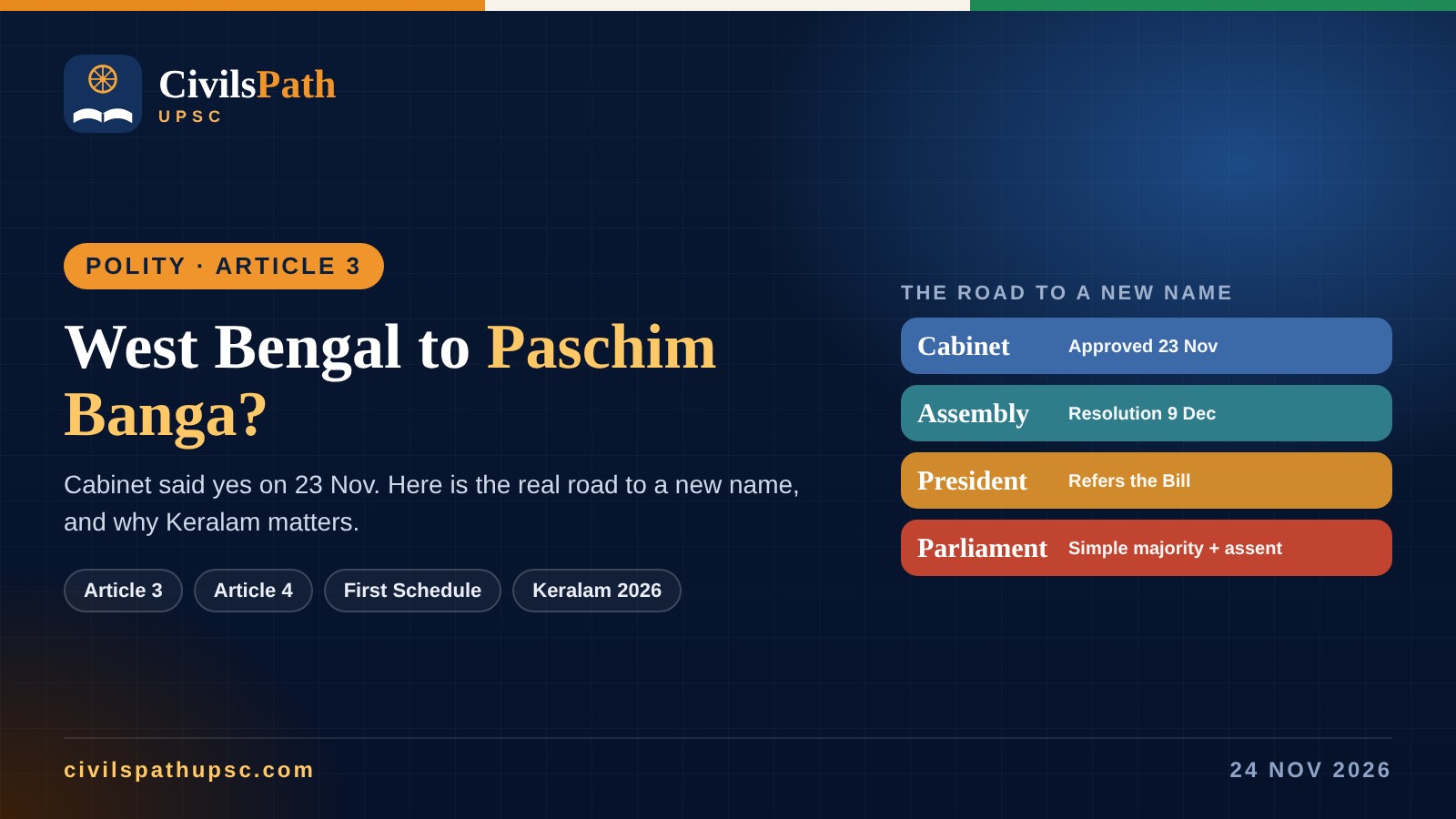
The short answer: only Parliament can rename a State
A Cabinet decision or an Assembly resolution does not change a State's name. Under Article 3 of the Constitution, Parliament alone can, by law, alter the name of any State.
Approves the proposal (done on 23 November 2026).
Passes a resolution and sends it to the Centre (planned for 9 December 2026).
Ministry of Home Affairs examines it; a Bill is drafted.
Recommends the Bill and refers it to the State legislature for its views within a set time. The views are not binding.
Both Houses pass it by simple majority; the President assents; the First Schedule is updated.
Why Keralam matters right now
Kerala is the freshest precedent. The Kerala Assembly unanimously backed the change, Parliament passed the Kerala (Alteration of Name) Bill, 2026 in August (Lok Sabha on 11 August, Rajya Sabha on 12 August), and the President gave assent. The State is now officially Keralam. The same route is open to West Bengal.
| Old name | New name | Year |
|---|---|---|
| Madras | Tamil Nadu | 1969 |
| Mysore | Karnataka | 1973 |
| Pondicherry (UT) | Puducherry | 2006 |
| Uttaranchal | Uttarakhand | 2007 |
| Orissa | Odisha | 2011 |
| Kerala | Keralam | 2026 |
Fifty years of trying: Bengal's long name story
The idea is old. It was reportedly raised in the 1970s. In 1999 the Left Front government pursued a change. In 2011 the Assembly passed a resolution for 'Paschim Banga', but the Bill was never tabled. In 2016 the State proposed three names ('Bangla' in Bengali, 'Bengal' in English, 'Bangal' in Hindi); the Centre objected to different names in different languages. In 2018 the Assembly asked for 'Bangla' in all languages; the Centre reportedly worried about confusion with Bangladesh. None of these went through.
Why change the name at all?
Identity and history: supporters say 'Paschim Banga' is how the State is already known in Bengali and keeps the memory of Partition, when the eastern half became East Pakistan and later Bangladesh.
The alphabet problem: 'West Bengal' starts with W, so the State often comes last in alphabetical lists at national meetings, when time and attention are short. 'Paschim Banga' moves it up, though not to the top.
Critics' view: name changes cost money (signboards, records, maps) and can be symbolic politics while real issues wait. A fair answer in the exam mentions both.
Facts to remember for Prelims
Article 3: Parliament may by law alter the name of any State.
Article 3 proviso: Bill needs the President's recommendation and reference to the State legislature.
Article 4: Laws under Articles 2 and 3 are not amendments under Article 368.
First Schedule: Lists the names and territories of States and Union Territories.
Keralam: Kerala renamed by the Kerala (Alteration of Name) Act, 2026.
Odisha: Orissa renamed in 2011.
Uttarakhand: Uttaranchal renamed in 2007.
Tamil Nadu: Madras State renamed in 1969.
Paschim Banga proposal: West Bengal Cabinet approved it on 23 November 2026; Assembly resolution planned on 9 December 2026.
Practice for Mains
Also read: Sheikh Hasina and the extradition question · Free UPSC study tools
Sources: Khaleej Times: Hasina's planned return · Outlook: India says courts will decide · ThePrint: Can India extradite Hasina · Outlook: Paschim Banga proposal · Onmanorama: Keralam assent · ThePrint: Amur falcons' migration · Dawan Africa: Amur falcon 5,700 km
Based on public reports and official statements available on 24 November 2026. CivilsPath takes no political side; positions of each side are reported as stated. Check later news for developments.