Why does Sheikh Hasina want to return to Bangladesh despite arrest warnings? Extradition, asylum and India's dilemma explained
A former Prime Minister, sentenced to death at home, living in New Delhi for over two years, says she will go back in December. The government in Dhaka says she will be arrested the moment she crosses the border. And India sits in the middle. This is one of the most closely watched stories in South Asia right now, and every part of it is UPSC material.
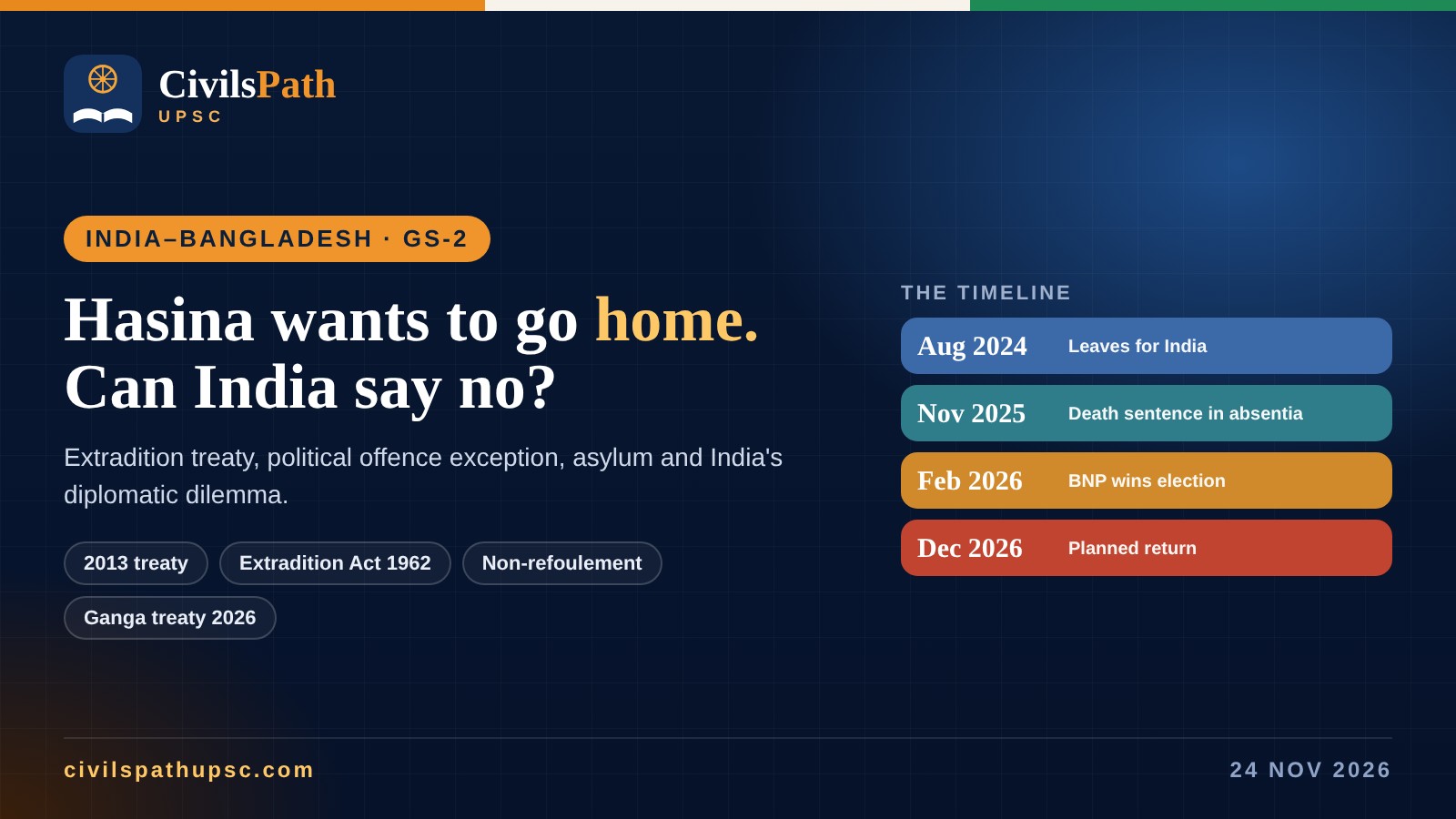
What has happened so far
Student-led uprising in Bangladesh; Sheikh Hasina leaves for India and has stayed in New Delhi since.
Bangladesh's International Crimes Tribunal sentences her to death in absentia for crimes against humanity linked to the 2024 crackdown. The UN estimates up to 1,400 people were killed in that period.
General election held with the Awami League barred. The BNP wins; Tarique Rahman becomes Prime Minister.
Dhaka formally asks India to extradite her under the 2013 treaty. India's MEA says it is examining the request 'in accordance with our established procedures'.
Her request for a new passport is rejected. She repeats that she will return in December; Bangladesh says she will be arrested on arrival.
Why would she go back?
Hasina herself has said she knows she could be jailed or even executed, and still wants to return. Her party says she will come back with or without documents. Several reasons are discussed in public debate:
Political survival: the Awami League, which ruled for 15 years, is barred from politics. A leader in exile cannot rebuild a party on the ground.
The narrative: her side calls the trial unfair and politically driven. Returning, and even facing arrest, turns the case into a public political contest rather than a verdict delivered in her absence.
Ending the limbo: at 78, without a passport and with a death sentence, staying in India indefinitely offers no clear future either.
Her opponents see it differently: they say she must face justice for the deaths of 2024, and that a return would be an attempt to stir unrest. Both readings are part of the story.
The legal heart of it: can India be forced to hand her over?
India and Bangladesh signed an extradition treaty in 2013 (amended in 2016). Extradition means one country formally surrenders a person to another country to face trial or punishment. But no treaty is automatic.
| Provision | What it says | Why it matters here |
|---|---|---|
| Political offence exception (Treaty) | Extradition may be refused if the offence is of a political character | Murder, terrorism, kidnapping and similar crimes are excluded from this exception, so the label 'political' is contested |
| Good-faith ground (Treaty) | Refusal is possible if the accusation is not made in good faith in the interests of justice | Her side says the trial was unfair; Dhaka says it was lawful |
| Extradition Act, 1962, Section 31 | No surrender for an offence of a political character or a politically motivated request | Indian law gives the government discretion |
| Extradition Act, Section 34A | If India does not surrender a person, it may prosecute in India | A middle path that exists on paper |
| Dual criminality | The act must be a crime in both countries | Indian courts would check this |
Indian officials have said the final decision will be taken through the courts and will not be 'a political or diplomatic decision'. In practice, extradition cases in India go through a magistrate's inquiry, appeals and a final government order, so they can take years.
India's dilemma
Hand her over, and India is seen to abandon a long-time partner who faces a death sentence. Refuse, and relations with the new elected government in Dhaka suffer. India's interests in Bangladesh are huge:
| Stake | Detail |
|---|---|
| Border | About 4,096 km, India's longest land border with any country; West Bengal, Assam, Meghalaya, Tripura and Mizoram touch it |
| Water | The Ganga Water Treaty of 1996 runs for 30 years and is due to expire in December 2026; the Teesta issue is still open |
| Connectivity | Routes to the North-East through Bangladesh, ports such as Chattogram and Mongla |
| Security | Insurgent groups, border crime and illegal migration need Dhaka's cooperation |
| Strategy | China's growing role in Bangladesh; BIMSTEC and Bay of Bengal cooperation |
So far India has chosen time: examining the request, letting courts lead, and keeping channels open with the new government. That is classic diplomatic hedging.
Quick Prelims notes
India–Bangladesh Extradition Treaty: Signed in 2013 and amended in 2016.
Extradition Act, 1962: Indian law on surrender of fugitives; Section 31 bars surrender for political offences.
International Crimes Tribunal: Bangladesh court that sentenced Sheikh Hasina to death in absentia in November 2025.
Bangladesh election 2026: Held in February; BNP won and Tarique Rahman became Prime Minister.
India–Bangladesh border: About 4,096 km, India's longest international land border.
Ganga Water Treaty: Signed in 1996 for 30 years; sharing of Ganga waters at Farakka.
Non-refoulement: Principle against returning a person to a country where they face serious harm.
1951 Refugee Convention: India is not a party to it or to its 1967 Protocol.
Write this for Mains
Also read: The Hindu analysis, 23 November 2026 · Places in News map
Sources: Khaleej Times: Hasina's planned return · Outlook: India says courts will decide · ThePrint: Can India extradite Hasina · Outlook: Paschim Banga proposal · Onmanorama: Keralam assent · ThePrint: Amur falcons' migration · Dawan Africa: Amur falcon 5,700 km
Based on public reports and official statements available on 24 November 2026. CivilsPath takes no political side; positions of each side are reported as stated. Check later news for developments.