Supreme Court orders red 'HIGH SUGAR, HIGH SALT, HIGH FAT' warnings on packaged food: what changes and why it matters for UPSC
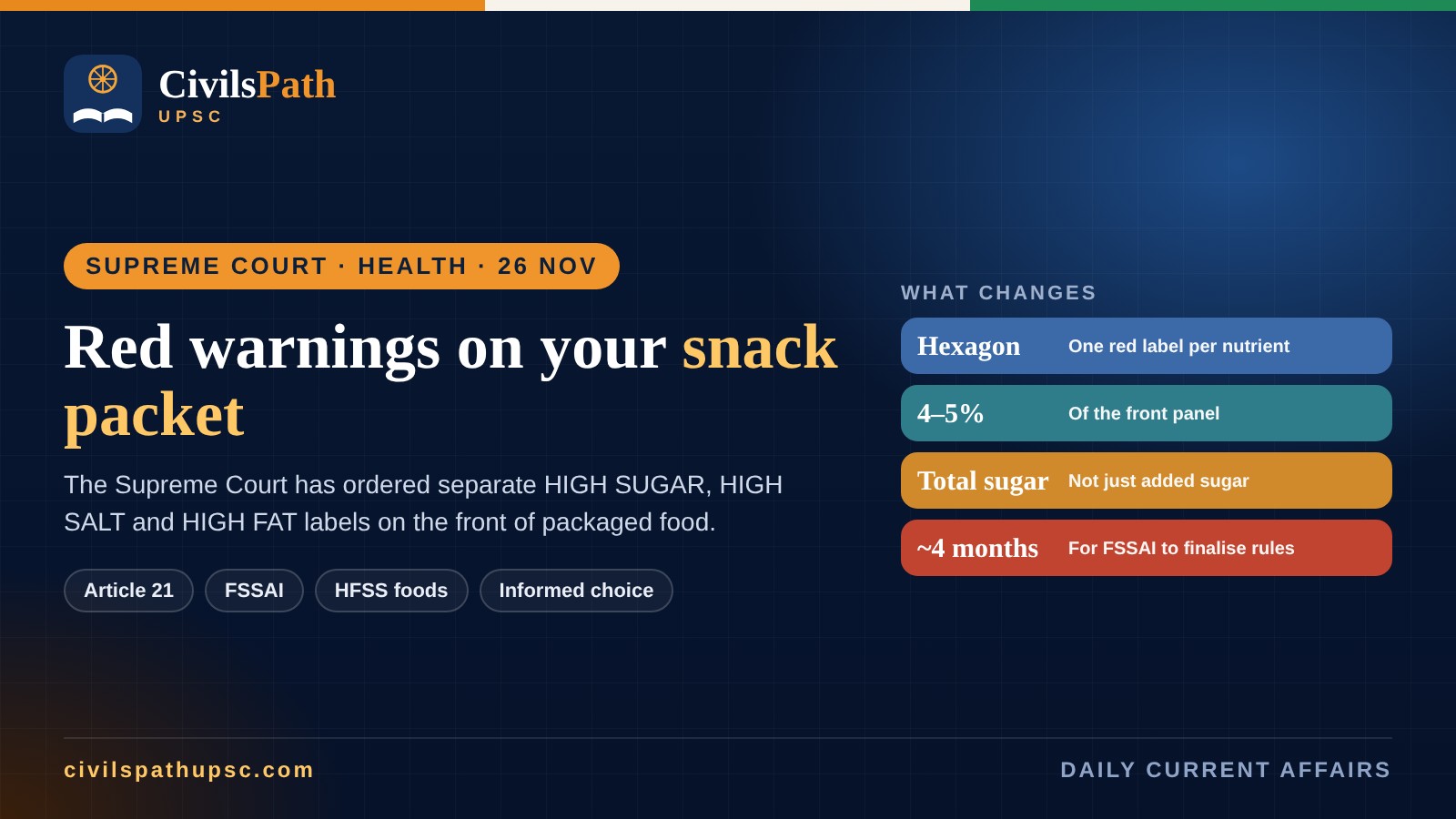
Pick up a packet of chips, a cold drink or a pack of biscuits a year or so from now, and you may see a red hexagon on the front saying HIGH SALT, HIGH SUGAR or HIGH FAT. On 26 November 2026, Constitution Day, the Supreme Court directed the Food Safety and Standards Authority of India (FSSAI) to put such warnings on packaged foods. The Court linked this to the right to health and the right of every consumer to make an informed choice. "We couldn't have pronounced on any better day than Constitution Day," Justice J.B. Pardiwala remarked.
What did the Court order?
A Bench of Justices J.B. Pardiwala and K. Vinod Chandran decided a public interest litigation filed under Article 32 by 3S and Our Health Society. The petition asked for mandatory front-of-pack warning labels on foods high in fat, sugar and salt (HFSS foods). The key directions, as reported:
| Issue | What the Court directed |
|---|---|
| Separate hexagons | One red hexagon for each nutrient of concern. A product high in both sugar and salt will carry two hexagons, not one combined label |
| Words + pictogram | Each warning must show 'HIGH FAT', 'HIGH SUGAR' or 'HIGH SALT' with a standard picture, so that people who cannot read English also understand |
| Size | Each hexagon should cover about 4–5% of the principal display panel (the front of the pack), following international practice |
| Font | FSSAI must fix a font size so the warning is 'prominent, conspicuous and readily legible' at the time of purchase |
| Total, not added | Thresholds must use total sugars and saturated fat, not 'added sugar' and 'added fat'. The Court rejected FSSAI's added-sugar formula |
| Thresholds | To be recalculated on evidence. Too low, and every product carries a warning (label fatigue); too high, and harmful products escape |
| Timeline | About four months to finalise the rules (60-day public and WTO consultation included), then a transition period for industry; no routine extensions |
| Other | A scientific list of exempt foods, rules for beverages, checks on recipes changed only to dodge labels, and nutrition literacy in school curricula |
| Follow-up | The case will be listed again after 10 weeks for FSSAI's progress affidavit |
How did we get here?
FSS (Labelling and Display) Regulations, 2020 notified. Front-of-pack labelling was left for later.
FSSAI's draft proposes an 'Indian Nutrition Rating', a star rating from 0.5 to 5 stars. Health experts criticise it, saying stars can make unhealthy food look healthy.
Supreme Court gives FSSAI three months to decide on front-of-pack labelling.
FSSAI proposes a single red hexagon in two phases. On 10 September the Court asks FSSAI 13 questions, including why one combined hexagon and why no pictures.
Judgment reserved after the Court questions a 365-day voluntary period.
Judgment: separate red hexagons, total sugar and saturated fat, 4–5% size, strict timeline.
Why does India need this?
India is facing a fast rise in non-communicable diseases (NCDs) such as diabetes, heart disease and hypertension. A few numbers explain the urgency:
| Indicator | Figure | Source |
|---|---|---|
| People with diabetes | About 10.1 crore | ICMR-INDIAB study, 2023 |
| People with prediabetes | About 13.6 crore | ICMR-INDIAB study, 2023 |
| Women overweight or obese | 24% | NFHS-5 (2019–21) |
| Men overweight or obese | 22.9% | NFHS-5 (2019–21) |
| Share of disease burden linked to unhealthy diets | 56.4% | Dietary Guidelines for Indians, ICMR-NIN, 2024 |
The back-of-pack nutrition table exists today, but it is in small print, in grams per 100 g, and very few shoppers read it in a hurry. A front-of-pack warning turns that table into a two-second message. This is why the WHO recommends interpretive front-of-pack labels.
Lessons from the world
| Country | Model | Result reported |
|---|---|---|
| Chile (2016) | Black octagons saying 'ALTO EN' (high in) sugar, salt, fat and calories; limits on advertising to children | Studies found a fall in purchase of sugary drinks and many companies changed recipes |
| Mexico (2020) | Black octagon warnings | Adopted by several Latin American countries after Chile |
| Australia, New Zealand | Health Star Rating (voluntary) | Criticised because sugary cereals can still score well |
| France and parts of Europe | Nutri-Score, A to E with colours | Summary score, not a warning |
The debate: both sides
| Arguments in favour | Concerns raised |
|---|---|
| Right to health and informed choice under Article 21 | Food industry worries about cost of new packaging and sudden change |
| Simple warning works even for people with low literacy | Traditional Indian snacks and small businesses may be hit |
| Pushes companies to cut sugar, salt and fat in recipes | Risk that companies replace sugar with artificial sweeteners or additives |
| Supports national NCD and Fit India goals | Red colour may confuse people used to the red/brown non-veg dot (the Court itself raised this in September) |
| Prevention is cheaper than treatment | Labels alone are not enough without awareness, taxes, and limits on advertising to children |
Where this fits in the syllabus
| Paper | Topic | Angle |
|---|---|---|
| GS-2 | Fundamental rights; judiciary | Article 21 (right to health, food, informed choice); judicial activism vs separation of powers; PIL under Article 32 |
| GS-2 | Health; statutory bodies | FSSAI under the FSS Act 2006; NCD policy; regulatory capture debate |
| GS-3 | Food processing industry | Labelling, reformulation, cost for MSMEs, consumer protection |
| GS-4 | Ethics | Corporate responsibility vs profit; nudge theory and paternalism |
| Essay | Health and society | 'Health is the first wealth' or 'The consumer is king only when informed' |
Fixes that can work
Notify the rules on time: thresholds based on science, open public consultation, and no repeated extensions.
Pair labels with awareness: school nutrition literacy (as the Court directed), mass media campaigns and Eat Right India.
Protect children: restrict advertising of HFSS foods to children, and keep junk food away from school canteens.
Help small producers: longer transition and technical help for MSMEs, without exempting harmful products.
Watch for loopholes: test reformulated products and monitor the use of sweeteners and additives.
Prelims pointers
Case name: 3S and Our Health Society v. Union of India, decided on 26 November 2026.
Bench: Justices J.B. Pardiwala and K. Vinod Chandran.
HFSS foods: Foods high in fat, sugar and salt.
FOPNL: Front-of-pack nutrition labelling.
Warning shape: Separate red hexagon for each nutrient of concern, with words and a pictogram.
Label size: About 4 to 5 percent of the principal display panel.
Nutrients of concern: Total sugars, saturated fat and salt (sodium).
FSSAI: Statutory body under the Food Safety and Standards Act, 2006, under the Ministry of Health and Family Welfare.
Labelling and Display Regulations: FSS (Labelling and Display) Regulations, 2020.
Indian Nutrition Rating: FSSAI's 2022 draft star rating from 0.5 to 5 stars, criticised by health experts.
Chile model: Black octagon 'ALTO EN' warning labels introduced in 2016.
Dietary Guidelines for Indians: Released by ICMR-National Institute of Nutrition, Hyderabad, in 2024.
Mains corner
Keywords for your answer
Informed choice · HFSS foods · interpretive labelling · label fatigue · reformulation · nudge · NCD burden · regulatory capture · continuing mandamus · Eat Right India.
Also read: SAMPADA survey and anaemia · Why the Centre told Netflix not to stream Pakistani content
Sources: The South First: SC directs FSSAI (26 Nov 2026) · LawBeat: Right to make an informed choice · Deccan Herald · The Logical Indian · Verdictum: 13 questions to FSSAI (Sept 2026) · Supreme Court order, 9 April 2025 (PDF)
Based on reports of the Supreme Court judgment of 26 November 2026 in 3S and Our Health Society v. Union of India, earlier orders in the case and public health data cited in the text. Exact nutrient thresholds will be known only when FSSAI notifies the regulations.