SAMPADA survey: Is India's anaemia really falling? What ICMR's new data says, and what it hides
For years, every national survey told the same grim story: two in three Indian children and more than half of Indian women were anaemic. On 23 November 2026, the Indian Council of Medical Research (ICMR) released a new national survey called SAMPADA with lower numbers. Headlines said 'anaemia has fallen'. The truth is more interesting, and it is exactly the kind of analysis UPSC rewards: part of the fall is real, part of it comes from a better way of measuring, and one group has barely moved at all: women.
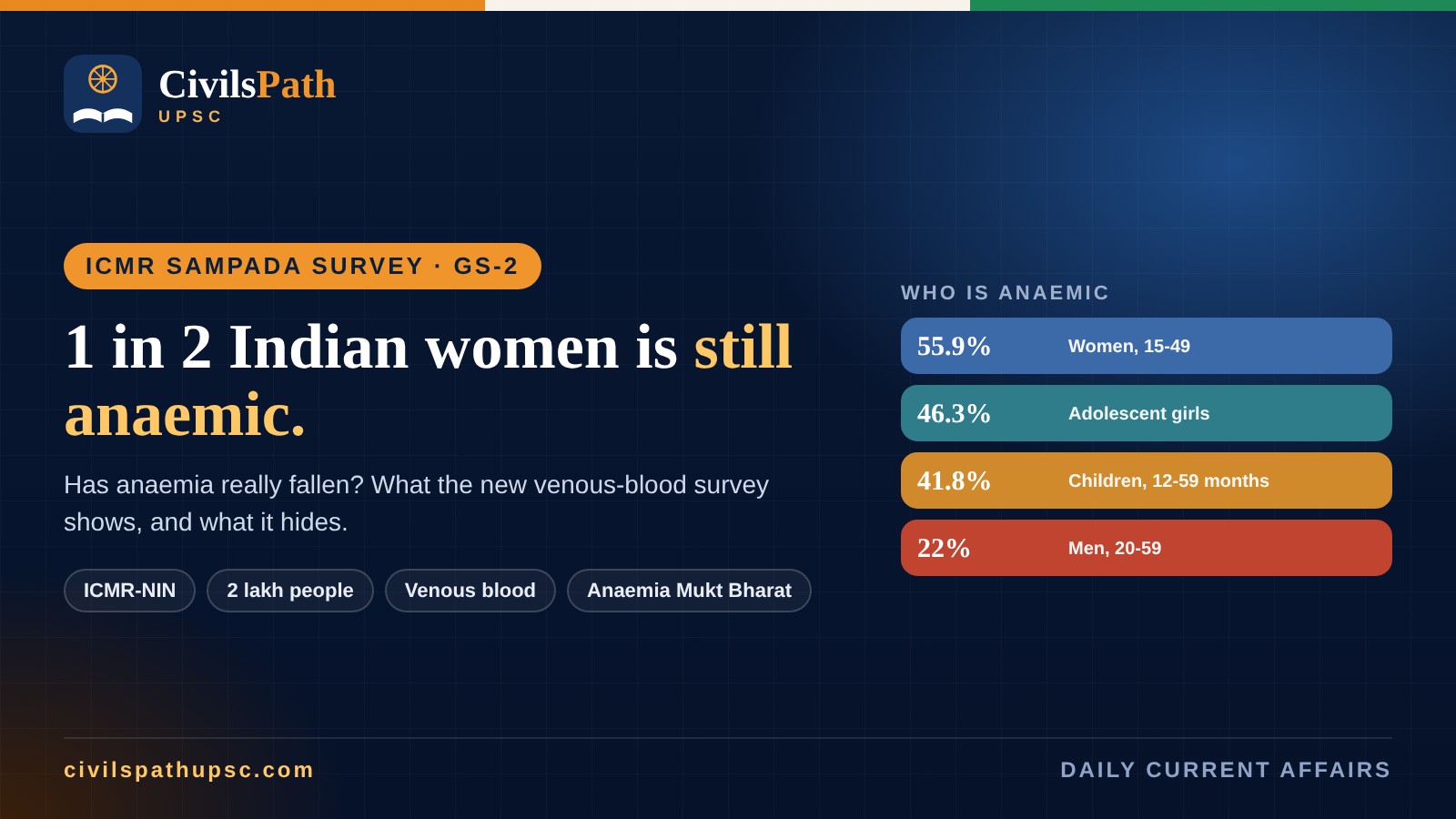
What is SAMPADA?
| Feature | Detail |
|---|---|
| Full name | Survey for Assessment of Markers of Population Health, Activity, Diet and Anthropometry |
| Conducted by | ICMR, through ICMR-National Institute of Nutrition (NIN), Hyderabad; Department of Health Research, Ministry of Health and Family Welfare |
| Period | 2023 to 2025 (earlier called the Diet and Biomarkers Survey) |
| Coverage | Over 2 lakh people in more than 81,000 households, 183 districts, 35 States and UTs |
| Blood tests | Over 1.7 lakh samples analysed for haemoglobin |
| Method | Venous blood (from a vein) tested on automated analysers, called the 'gold standard' |
| Extra tests | In a sub-sample: iron status, folate, vitamin B12, and inflammation markers (CRP, AGP) |
| Released | 23 November 2026 |
The headline numbers
Severity: most anaemia is mild. About half of anaemic women, girls and children have mild anaemia; among anaemic boys and men, about three-quarters. Severe anaemia is below 2% in most age groups.
Causes: iron deficiency explains about half of anaemia in women, adolescent girls and young children. Vitamin B12 and folate deficiency were just as common in people without anaemia, so they seem to add little. The rest is linked to infections, inflammation and inherited blood disorders such as thalassaemia and sickle cell disease.
The gender gap is the real story: an adolescent girl is about twice as likely to be anaemic as a boy of the same age, and a woman more than twice as likely as a man.
So, has anaemia really fallen? Read the method first
Compare SAMPADA with the National Family Health Survey (NFHS-5, 2019-21):
| Group | NFHS-5 (2019-21) | SAMPADA (2023-25) |
|---|---|---|
| Young children | 67.1% (6-59 months) | 41.8% (12-59 months) |
| Women of reproductive age | 57.0% | 55.9% |
| Pregnant women | 52.2% | about 44% (as reported) |
| Adolescent girls | 59.1% (15-19) | 46.3% (10-19) |
| Men | 25.0% (15-49) | 22% (20-59) |
Looks like a big fall for children. But look closer:
1. Different blood: NFHS used a drop of capillary blood from a finger prick, tested on a portable device. SAMPADA used venous blood on lab analysers. Finger-prick readings can vary, and experts long argued they over-estimate anaemia. That is why NFHS-6 did not publish a national anaemia estimate, and why the Government said SAMPADA would provide it.
2. Different age bands: NFHS-5 counted children from 6 months; SAMPADA from 12 months. Babies of 6-11 months have the highest anaemia, so leaving them out lowers the number.
3. The tell-tale check: the Comprehensive National Nutrition Survey (CNNS, 2016-18), which also used venous blood, found about 41% of pre-school children anaemic. SAMPADA's 41.8% is almost the same. So with the same method, children's anaemia has been roughly flat, not halved.
4. Women have hardly moved: 57% then, about 56% now. Whatever the method, more than half of Indian women remain anaemic, the most worrying finding of all.
Why anaemia matters so much
Mothers and babies: anaemia in pregnancy raises the risk of maternal death, premature birth and low birth weight.
Brains and schools: iron deficiency in early childhood can affect cognitive development and learning.
Work and growth: tired, anaemic workers are less productive; studies have linked anaemia to large losses in national income.
Global goals: anaemia in women aged 15-49 is an SDG indicator (2.2.3), and the World Health Assembly target is to halve it, now extended to 2030.
Why does India's anaemia refuse to go away?
Diet: low intake of iron-rich and diverse foods, and poor absorption (for example, too little vitamin C with meals, tea with food).
Infections and worms: malaria, hookworm and repeated infections cause blood loss and inflammation.
Inherited disorders: sickle cell disease and thalassaemia are common in some tribal and regional populations.
Gender: early marriage, early and frequent pregnancies, and women eating last and least in many households.
Environment: a 2025 IIT Delhi study linked higher air pollution with greater anaemia risk among women.
Programme gaps: iron-folic acid (IFA) tablets reach many, but taking them regularly, deworming and follow-up of severe cases remain weak.
What the Government is doing
| Programme | What it does |
|---|---|
| Anaemia Mukt Bharat (2018) | 6x6x6 strategy: 6 target groups, 6 interventions, 6 institutional mechanisms; aims to cut anaemia by 3 percentage points a year |
| Six interventions | Prophylactic IFA supplements, deworming, behaviour change (including delayed cord clamping), digital testing and treatment, fortified foods in government programmes, tackling non-nutritional causes |
| AMB 2.0 (as mentioned by ICMR) | Test and track people with moderate or severe anaemia until it is resolved |
| POSHAN Abhiyaan (2018) | National Nutrition Mission for children, adolescent girls, pregnant women and lactating mothers |
| Fortified rice | Iron-fortified rice supplied through the PDS and welfare schemes |
| National Sickle Cell Anaemia Elimination Mission (2023) | Screening and care, aiming to eliminate sickle cell disease as a public health problem by 2047 |
Under Anaemia Mukt Bharat, 95% of registered pregnant women received the recommended 180 IFA tablets in 2023-24, but coverage of other groups and actual consumption lag behind.
A State snapshot: Tamil Nadu
| Group | Tamil Nadu | India |
|---|---|---|
| Women, 15-49 | 52.8% | 55.9% |
| Children, 12-59 months | 43.3% | 41.8% |
| Adolescent girls | 35.9% | 46.3% |
| Men, 20-59 | 17.3% | 22% |
Even a State with strong health systems has more than half its women anaemic. Anaemia is not only a poverty problem; it is a gender and nutrition-quality problem.
What can be done
Use the new baseline: repeat SAMPADA-style venous surveys regularly so that trends are real, not artefacts of method.
Go beyond iron: screen for sickle cell and thalassaemia, treat infections and worms, and improve diet diversity through millets, pulses, eggs and greens.
Focus on adolescent girls: anaemia before pregnancy shapes the health of the next generation; school-based weekly IFA and nutrition education matter.
Follow up severe cases: test, treat and track, as AMB 2.0 proposes.
Fix the social roots: delay marriage and first pregnancy, and change household norms on who eats what.
Prelims facts at a glance
SAMPADA: Survey for Assessment of Markers of Population Health, Activity, Diet and Anthropometry by ICMR-NIN (2023-25).
SAMPADA coverage: Over 2 lakh people, 81,000 households, 183 districts, 35 States and UTs.
SAMPADA method: Venous blood tested on automated analysers.
Women anaemic (SAMPADA): About 56% of women of reproductive age.
Children anaemic (SAMPADA): 41.8% of children aged 12-59 months.
Adolescent girls anaemic (SAMPADA): 46.3%, about twice the rate in boys (22.8%).
Main cause: Iron deficiency explains about half of anaemia in women, girls and young children.
NFHS-5 child anaemia: 67.1% of children aged 6-59 months, measured with capillary blood.
CNNS 2016-18: Used venous blood; found about 41% of pre-school children anaemic.
Anaemia Mukt Bharat: Launched in 2018 with a 6x6x6 strategy.
ICMR-NIN: National Institute of Nutrition, Hyderabad.
SDG indicator 2.2.3: Prevalence of anaemia in women aged 15-49.
National Sickle Cell Anaemia Elimination Mission: Launched in 2023 with a 2047 goal.
Mains practice
Words that fetch marks
Hidden hunger · micronutrient deficiency · venous vs capillary sampling · test-treat-track · life-cycle approach · haemoglobinopathies · dietary diversity · intergenerational cycle of malnutrition · gender norms in food.
Also read: The Hindu analysis, 24 November 2026 · Revision flashcards · Daily Mains answer writing
Sources: PIB: ICMR SAMPADA survey · ICMR-NIN · Outlook: Why India remains anaemic · Daijiworld: SAMPADA vs NFHS-5 · The Wire: NFHS indicators · Anaemia Mukt Bharat
Based on the ICMR press release of 23 November 2026 (PIB), the SAMPADA factsheet, NFHS-5 and CNNS reports, and news reports. Some group-wise figures (such as pregnant women) are as reported in the media; check the official factsheet at nin.res.in for exact values.