Child marriage in India: the law is ready, is society? A research analysis on the first UN International Day (27 November)
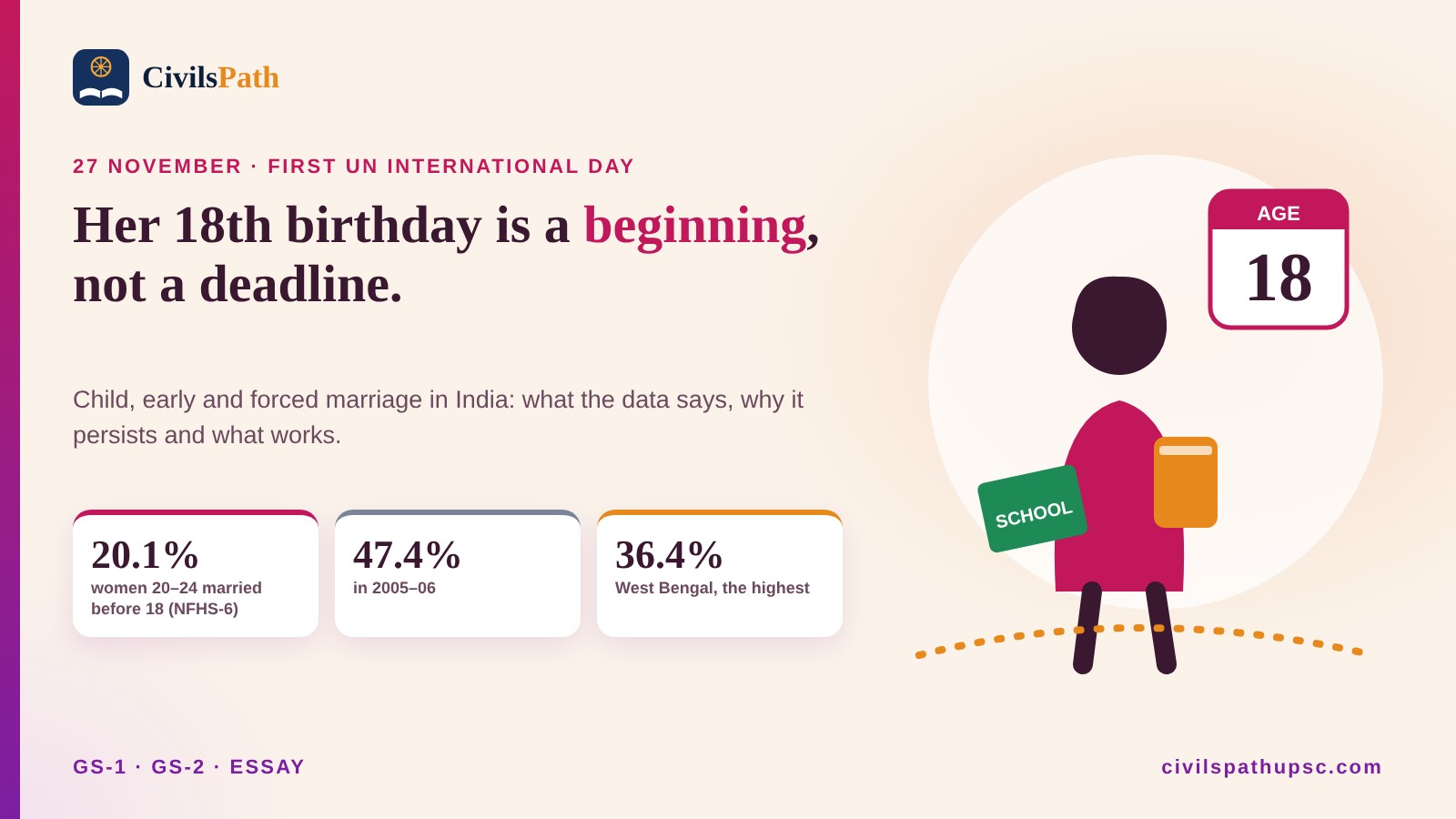
On 27 November 2026, the world observed something for the first time: the International Day for the Elimination of Child, Early and Forced Marriage. The UN General Assembly created the day by consensus in September, with Sierra Leone leading and India among about 70 co-sponsors. The date was chosen because on 27 November 2024 India launched its Bal Vivah Mukt Bharat campaign. That makes the day both a global milestone and a test for India: the country has cut child marriage by more than half in two decades, yet one in five young Indian women was still married as a child.
1. What counts as child marriage?
The UN defines child marriage as any formal marriage or informal union where at least one party is under 18. 'Early' marriage also covers people above 18 who are not yet ready, and 'forced' marriage is any marriage without the full and free consent of both. In India, the Prohibition of Child Marriage Act, 2006 (PCMA) defines a child as a woman under 18 or a man under 21.
2. The numbers: real progress, uneven map
| What the data hides | Why it matters |
|---|---|
| Rajasthan barely moved (25.4% to 24.6%) | Customs like 'aata-saata' (bride exchange) and mass weddings on Akha Teej keep the practice alive |
| West Bengal is still the highest despite Kanyashree | Cash incentives alone do not shift norms where early marriage is linked to elopement, migration and safety fears |
| Rural vs urban gap | Rural girls marry much earlier; poverty and distance from secondary school matter most |
| Education is the strongest predictor | NFHS-5: about 48% of women with no schooling married before 18, against 4% with higher education |
Globally, an estimated 640 million women and girls alive today were married in childhood. South Asia carries the largest share, and India, by sheer population, accounts for roughly a third of the world's child brides. SDG target 5.3 calls for ending child marriage by 2030; at the current pace, the world will miss it by decades.
3. Why it still happens
| Driver | How it works |
|---|---|
| Poverty and dowry | Younger brides often mean lower dowry; one less mouth to feed |
| 'Protection' of honour | Fear of elopement, harassment or 'love marriage' leads parents to marry daughters early |
| School drop-out | No secondary school nearby, especially after Class 8, removes the main alternative to marriage |
| Customs | Bride exchange, mass weddings on auspicious days, and marriages fixed in childhood with 'gauna' later |
| Weak enforcement | Few prosecutions; families and communities rarely report; officers often double up on other duties |
| Crises | Floods, migration, COVID-19 and debt push families towards early marriage |
4. Why it matters: the cost of a stolen childhood
Health: Early pregnancy raises risks of maternal death, anaemia and low birth weight. Girls aged 15–19 who are already mothers or pregnant are far more common in high-prevalence States.
Education and work: Marriage usually ends schooling, which in turn keeps women out of paid work, one reason India's female labour force participation is low.
Violence and rights: Child brides face more domestic violence and have little say in decisions. In Independent Thought v. Union of India (2017), the Supreme Court held that sex with a wife under 18 is rape.
Intergenerational cycle: Children of child brides are more likely to be stunted and to drop out, so poverty passes down.
5. The legal framework
| Law or judgment | Key provision |
|---|---|
| PCMA, 2006 | Child = woman under 18, man under 21; marriage voidable at the option of the party who was a child (Sec. 3); void in cases of trafficking or force (Sec. 12) |
| Punishments | Up to 2 years' jail and ₹1 lakh fine for an adult man marrying a child, those who solemnise it, and parents who promote it (Secs. 9–11); offences are cognizable and non-bailable (Sec. 15) |
| Prevention | Courts can issue injunctions to stop a marriage (Sec. 13); Child Marriage Prohibition Officers appointed by States (Sec. 16) |
| POCSO Act, 2012 | Any sexual act with a person under 18 is an offence |
| Independent Thought (2017) | Marital rape exception does not apply to wives under 18 |
| SC guidelines (Oct 2024) | Society for Enlightenment and Voluntary Action v. UoI: prevention-focused directions, special units in districts, and community awareness |
| 2021 Bill (lapsed) | Proposed raising women's marriage age to 21; it lapsed with the 17th Lok Sabha in 2024 |
6. What has worked
Bicycles in Bihar, scholarships and residential schools increase years of schooling, the single strongest protection.
West Bengal's Kanyashree pays an annual scholarship to girls in school and a one-time grant at 18 if unmarried; it helps, but only alongside norm change.
Assam's crackdown in 2023 led to thousands of arrests; it sent a strong signal but raised concerns about criminalising families and girls' welfare.
Gram panchayats declaring themselves child-marriage free, helplines (1098), and alert officers. Sikar (Rajasthan) prevented 29 child marriages in 2024.
The Hindu's Spotlight shows girls calling helplines and going to Family Courts to annul marriages; awareness camps helped them know the law.
A national campaign targeting high-burden States and districts, aiming to cut prevalence by 10% by 2026 and end child marriage by 2030.
7. The debate: law vs social change
| Argument | Counter-argument |
|---|---|
| Criminal law deters families and officials | Fear can push marriages underground and hurt the girl if her family is jailed |
| Raising the age to 21 would delay pregnancy and push education | Critics say it may criminalise consenting young couples and be misused by families against 'love marriages' |
| Cash transfers change incentives | Money without schools, safety and jobs does not change norms |
| Personal laws should yield to PCMA | Courts have differed; the SC in 2024 asked Parliament to consider whether PCMA overrides personal laws |
8. Way forward
Make secondary school reachable: a school within safe distance up to Class 12, with transport and hostels for girls.
Link welfare to milestones: tie scholarships and incentives to staying in school, not just staying unmarried.
Full-time protection officers: give Child Marriage Prohibition Officers dedicated staff, data dashboards and targets by district.
Track every girl: use school drop-out data and Anganwadi records to flag girls at risk before Akha Teej and wedding seasons.
Change norms: work with religious leaders, wedding service providers (priests, caterers, tent houses, printers) and boys and men.
Support those who say no: shelters, legal aid and annulment support for girls who refuse or escape marriages.
For UPSC
| Use it in | How |
|---|---|
| GS-1: Women, society | Social causes of child marriage, regional patterns, role of education |
| GS-2: Vulnerable sections, health | PCMA, POCSO, Bal Vivah Mukt Bharat, SDG 5.3, maternal and child health |
| GS-4: Ethics | Duty of officers vs community pressure; case studies on stopping a wedding |
| Essay | 'Educate a girl, and you delay a marriage and change a generation' |
Prelims facts at a glance
International Day: 27 November, first observed in 2026; UNGA resolution adopted by consensus in September 2026, led by Sierra Leone.
Bal Vivah Mukt Bharat: Launched on 27 November 2024; aims to end child marriage by 2030.
PCMA 2006: Child means a woman under 18 or a man under 21; replaced the Child Marriage Restraint Act, 1929 (Sarda Act).
Child Marriage Prohibition Officer: Appointed by the State Government under Section 16 of PCMA.
NFHS-6: 20.1 percent of women aged 20 to 24 married before 18; highest in West Bengal at 36.4 percent.
SDG 5.3: Eliminate child, early and forced marriage and female genital mutilation by 2030.
Childline: 1098 is the helpline number for children in distress.
Practice for Mains
Keywords: voidable marriage · CMPO · norm change · conditional cash transfer · Kanyashree · Bal Vivah Mukt Bharat · SDG 5.3 · agency of girls.
Also read: The Hindu analysis, 27 November 2026 · SAMPADA survey and anaemia
Sources: UN: International Day for the Elimination of Child, Early and Forced Marriage · IPS: UN declares international day (Sept 2026) · ETV Bharat: India co-sponsors UNGA resolution · SBI Research: NFHS-6 results (June 2026) · NFHS-6 India fact sheet · UNICEF: Ending child marriage in India · UNFPA: Child marriage insights from NFHS-5 · The Hindu Spotlight, 27 Nov 2026
A CivilsPath research article based on NFHS-6 data (as compiled by SBI Research), UN and UNICEF material, news reports and The Hindu's Spotlight report of 27 November 2026. Global estimates are rounded. No real person's photo is used; the stories referred to are as reported by the newspaper.