26/11 at 18: The night Mumbai bled, the heroes who stood, and how India rebuilt its security
Eighteen years ago tonight, on 26 November 2008, ten men stepped off rubber dinghies onto the shores of south Mumbai. For the next 60 hours, India's financial capital was under siege. A railway station full of families going home, a café full of travellers, two grand hotels, a hospital and a small Jewish centre became targets. When it ended, 166 people were dead and more than 300 injured. Today we remember them, salute those who ran towards the gunfire, and ask the question every UPSC aspirant must answer: what did India learn?
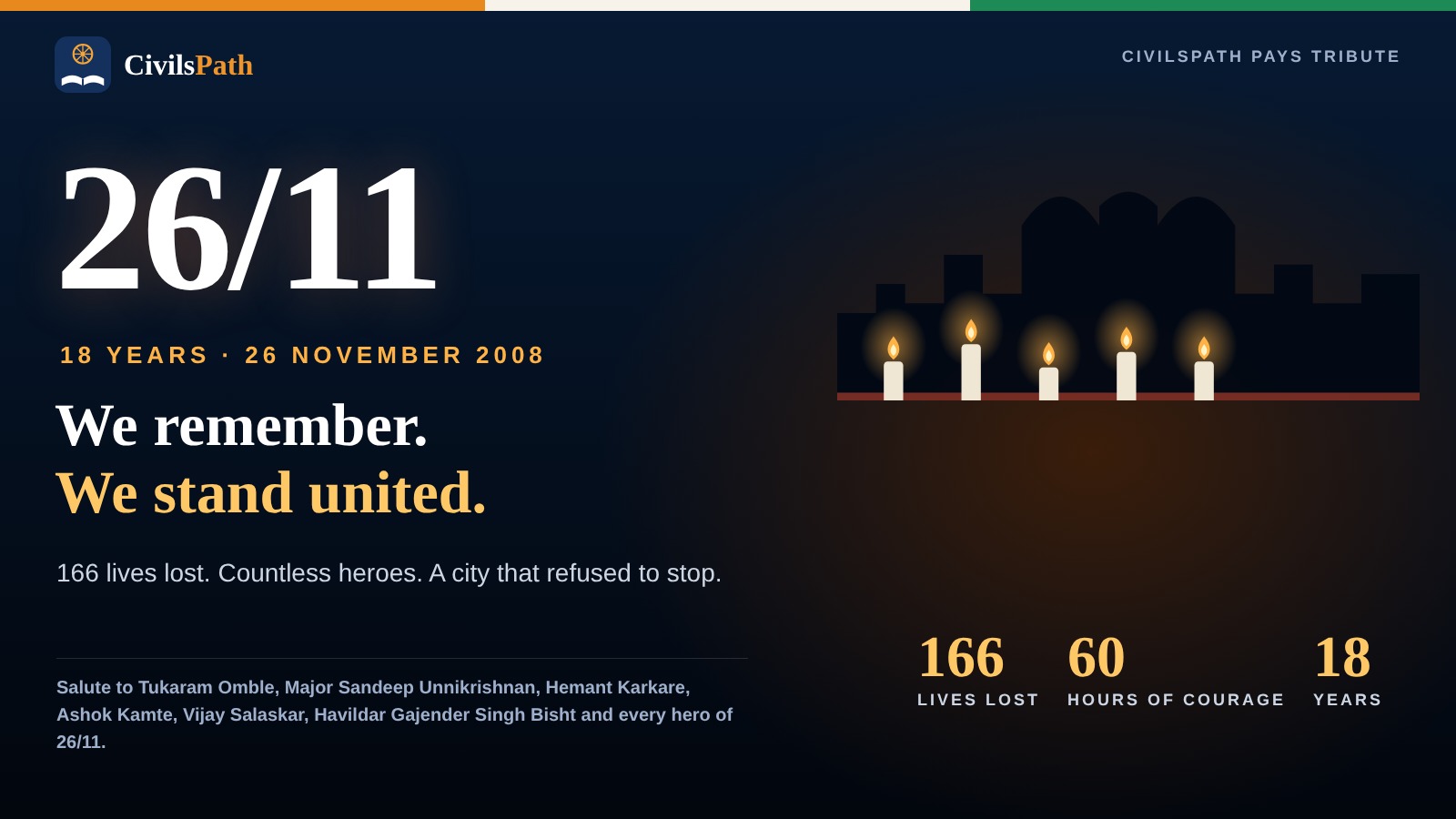
The 60 hours that changed India
Ten terrorists of the Pakistan-based Lashkar-e-Taiba (LeT) sailed from Karachi, hijacked the Indian fishing trawler MV Kuber, killed its crew and reached Mumbai's coast in inflatable dinghies.
Chhatrapati Shivaji Terminus (CST) railway station, Leopold Café, the Taj Mahal Palace hotel, the Oberoi-Trident hotel, Nariman House and Cama Hospital were attacked in small teams.
The attackers were guided in real time by handlers across the border, who also watched live television coverage.
The National Security Guard (NSG), Army and Navy commandos (MARCOS), and Mumbai Police cleared the sites one by one; the last, the Taj, was secured on 29 November.
Nine attackers were killed. Ajmal Kasab was captured alive, tried, and hanged in Pune's Yerwada jail on 21 November 2012.
The heroes we must never forget
Assistant Sub-Inspector Tukaram Omble, armed only with a lathi, threw himself on Kasab's rifle at Girgaum Chowpatty and took the bullets so his colleagues could capture the attacker alive. That one act gave India the proof of who was behind the attack.
Major Sandeep Unnikrishnan of the NSG led his men into the Taj and was killed while saving others; his last words to his team are remembered as 'Don't come up, I will handle them.' Havildar Gajender Singh Bisht of the NSG fell at Nariman House.
Mumbai ATS chief Hemant Karkare, Additional Commissioner Ashok Kamte and Inspector Vijay Salaskar were killed in the first hours while responding to the attack. Railway announcers, hospital staff and hotel employees, many of whom stayed to guide guests to safety, showed that heroism does not always wear a uniform.
What went wrong: the lessons
| Failure | What it meant |
|---|---|
| Intelligence not acted on | Inputs about a sea-borne threat to Mumbai existed but were not converted into action |
| Coastal gaps | A long, open coastline with thousands of fishing boats and weak patrolling |
| Slow response | NSG had to fly from Manesar near Delhi; it took hours to reach |
| Poor coordination | No single command among Police, Navy, Coast Guard, intelligence and the State |
| Outdated police equipment | Local police faced AK-47s with old rifles and weak body armour |
| Live media coverage | Handlers watched commando movements on live TV |
The Maharashtra government's High Level Enquiry Committee, headed by former Union Home Secretary R.D. Pradhan, examined these failures.
How India rebuilt its security after 26/11
| Reform | What changed |
|---|---|
| National Investigation Agency (NIA) | Created by the NIA Act, 2008, as a federal agency to investigate terror cases across States |
| UAPA amended (2008) | Stronger anti-terror law, with longer detention and special offences |
| NSG regional hubs | Hubs in Mumbai, Chennai, Kolkata and Hyderabad (2009) to cut response time |
| Three-tier coastal security | Navy for overall maritime security; Coast Guard for territorial waters; State marine police near the shore; coastal police stations built |
| Sagar Kavach exercises | Regular coastal security drills by Navy, Coast Guard, police and fishermen |
| Tracking boats and fishers | AIS transponders on boats, registration and biometric ID cards for fishermen |
| Information Management and Analysis Centre | Maritime information centre at Gurugram (2014), and the Information Fusion Centre for the Indian Ocean Region (2018) |
| Multi Agency Centre and NATGRID | Real-time intelligence sharing; NATGRID links databases for counter-terror agencies |
| Media rules | Cable TV rules amended (2015) to bar live coverage of anti-terror operations |
| State forces | Maharashtra raised Force One, a dedicated commando unit |
Since 2008, there has been no attack of the scale of 26/11 from the sea, which reflects how much the coastline is now watched.
The unfinished business: justice
Kasab's trial and conviction were the first proof in court. In April 2025, Tahawwur Rana, accused of helping plan the attack, was extradited from the United States to India to face trial. David Headley, who scouted the targets, is in a U.S. prison. In Pakistan, the trial of LeT commanders has dragged on for years. India continues to press for justice through diplomacy, the Financial Action Task Force (FATF) and UN sanctions. Link this with the extradition debate in our Hasina extradition explainer.
UPSC angle in detail
| Paper | Topic | How to use 26/11 |
|---|---|---|
| GS-3 | Linkages of organised crime with terrorism; role of external State and non-State actors | Cross-border terror, handlers, financing; FATF and UN listings |
| GS-3 | Security challenges and their management in border areas; coastal security | Three-tier coastal security, Sagar Kavach, IMAC, IFC-IOR |
| GS-3 | Various security forces and agencies and their mandate | NSG, NIA, Coast Guard, Navy, State police, MAC, NATGRID |
| GS-3 | Role of media and social networking in internal security | Live TV aided handlers; 2015 rule against live coverage |
| GS-2 | Federalism; Centre–State relations | Police and public order are State subjects; NIA's concurrent jurisdiction |
| GS-4 | Ethics in public service; courage; crisis leadership | Omble, Unnikrishnan, hotel staff |
| Essay | Terrorism, resilience, national unity | 'A city that refused to stop' |
Facts to remember for Prelims
26/11 attacks: 26 to 29 November 2008 in Mumbai; 166 killed and over 300 injured.
Attackers: Ten terrorists of the Pakistan-based Lashkar-e-Taiba who came by sea from Karachi.
MV Kuber: Indian fishing trawler hijacked by the attackers on the way to Mumbai.
Operation Black Tornado: NSG-led operation to clear the attacked sites in Mumbai.
Tukaram Omble: Mumbai Police ASI who held Kasab's rifle; awarded the Ashoka Chakra posthumously.
Sandeep Unnikrishnan: NSG Major killed at the Taj; awarded the Ashoka Chakra posthumously.
Ajmal Kasab: The only attacker captured alive; hanged on 21 November 2012 in Yerwada jail, Pune.
NIA: National Investigation Agency created under the NIA Act, 2008.
NSG: National Security Guard, raised in 1984 under the Ministry of Home Affairs; known as the Black Cats.
NSG regional hubs: Set up in 2009 at Mumbai, Chennai, Kolkata and Hyderabad.
Sagar Kavach: Coastal security exercise involving the Navy, Coast Guard and marine police.
IFC-IOR: Information Fusion Centre for the Indian Ocean Region at Gurugram, set up in 2018.
Tahawwur Rana: Accused in the 26/11 conspiracy; extradited from the U.S. to India in April 2025.
Mains corner
Keywords for your answer
Cross-border terrorism · sea-borne infiltration · three-tier coastal security · first responders · intelligence fusion · inter-agency coordination · force multipliers · resilience · fishermen as eyes and ears · operational security.
Also read: The Hindu analysis, 24 November 2026 · Revision flashcards
Sources: High Level Enquiry Committee (R.D. Pradhan) report; court records of the 26/11 trial. National Investigation Agency · National Security Guard · Indian Coast Guard · Ministry of Home Affairs · IFC-IOR, Indian Navy
Written by CivilsPath as a tribute and a UPSC explainer, based on official records, the Ram Pradhan committee report, court records and public reports. Figures are the commonly cited official figures.