UPSC age limit vs the world: How India's 32-year cap compares with China, Japan, the US, the UK and others
How old is too old to join the civil service? In India, a general-category candidate must be under 32 to sit the UPSC Civil Services Examination (CSE). Many advanced democracies set no upper age limit at all, while a few Asian countries keep one. This comparison matters because the debate on reducing the UPSC age limit and the number of attempts keeps coming back.
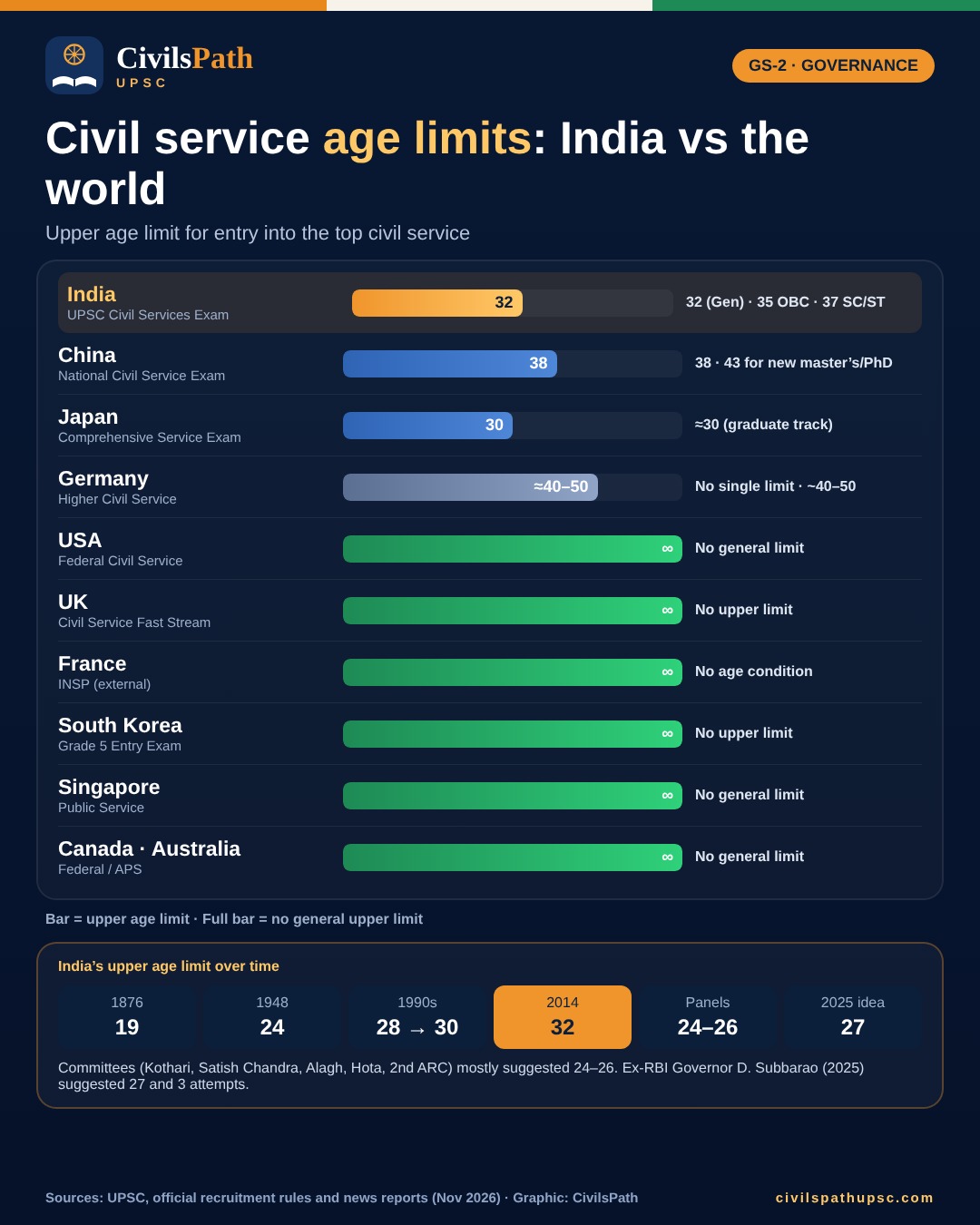
India: the current rules
The UPSC CSE allows candidates aged 21 to 32 in the general and EWS categories. The upper limit is relaxed by 3 years for OBC candidates (35) and 5 years for SC/ST candidates (37). Persons with benchmark disabilities get a further 10 years. Ex-servicemen also get relaxation.
The number of attempts is also capped: 6 for General and EWS, 9 for OBC and PwBD, and unlimited (within the age limit) for SC/ST candidates.
How other countries compare
China: The upper age limit for the national civil service exam was raised in October 2025 from 35 to 38, and to 43 for fresh master's and doctoral graduates. China described it as a step against workplace ageism, the "curse of 35".
Japan: The comprehensive (career-track) national exam for university graduates has an upper age limit of about 30.
Germany: There is no single national age limit. The federal government and each state set their own limits for permanent civil servants (Beamte). These are mostly around 40 to 50 today. The often-quoted figure of 35 is outdated.
United States: The federal civil service has no general upper age limit. Exceptions exist for jobs such as law enforcement and air traffic control.
United Kingdom: The Civil Service Fast Stream has no upper age limit.
France: The external competition of the Institut national du service public (INSP), which replaced ENA, has no age condition. It requires a degree and EU or EEA nationality.
South Korea: The Grade 5 senior civil service exam has no upper age limit, as upper limits were removed in 2009. The average age of successful candidates is around 28.
Singapore, Canada and Australia: Their public services have no general upper age limit.
A long history of debate in India
The age limit has changed many times. In 1876, the British cut it to 19, which led Indians to protest because it made it very hard for them to compete. After independence it stood at 24 (1948). It was raised to 28 and then 30 in the 1990s, and to 32 in 2014 after student protests.
Several committees have recommended a lower limit: the Kothari Committee (1976) and the Satish Chandra Committee (1989) suggested 26, the P.C. Hota Committee suggested 24, and the Second Administrative Reforms Commission (2008) suggested 25. In 2025, former RBI Governor D. Subbarao proposed lowering the limit to 27 with only three attempts, along with a separate mid-career entry at 40 to 42. As per reports in October 2025, the UPSC said it has no plans to reduce the age limit or the number of attempts.
Arguments for a lower age limit
1. Officers who join younger serve longer and can reach top posts with more years of experience.
2. Young officers may be easier to train and more open to new ideas.
3. Years spent on repeated attempts are lost to the economy and to the candidate's career.
4. Most successful candidates already clear the exam in their twenties.
Arguments for keeping or raising the limit
1. Candidates from poor, rural and Hindi-medium backgrounds often need more time and attempts to compete on equal terms.
2. Older entrants bring work experience from other fields.
3. Many democracies set no age limit and still have effective services.
4. China, which had a strict limit, has itself raised it to widen its talent pool.
The way forward
A balanced approach could keep the current age limit for social equity, while making the exam more predictable so that fewer years are wasted. This could include clear syllabus, fewer surprises, and quicker results. It could also add a separate, merit-based mid-career entry channel instead of ad hoc lateral entry. Any change should be gradual and announced well in advance so that current aspirants are not hurt.
Prelims facts
• UPSC CSE age: 21–32 (General/EWS); 35 (OBC); 37 (SC/ST); +10 years for PwBD.
• Attempts: 6 (General/EWS), 9 (OBC/PwBD), unlimited for SC/ST within the age limit.
• 1876: ICS upper age limit cut to 19 (Lord Salisbury).
• 2014: upper age limit raised to 32.
• China (Oct 2025): 35 → 38; 43 for new master's/PhD graduates.
• UPSC: constitutional body under Articles 315–323.
GS linkage
• GS-2 (Polity & Governance): UPSC (Articles 315–323), civil services reforms, social justice and reservation.
• GS-2: Role of civil services in a democracy, lateral entry.
• Essay: "Age is a number, ability is the measure."
Mains practice question
"Should India lower the upper age limit and the number of attempts in the Civil Services Examination?" Discuss with reference to international practices and the concerns of social equity. (15 marks, 250 words)
Sources: South China Morning Post (China age cap, Oct 2025); Business Today (D. Subbarao's proposals, May 2025); Newslaundry (history of the age limit); The Secretariat (UPSC@100, Oct 2025); official/expert pages on Japan, Germany and France recruitment rules. Always check the latest UPSC notification.
This article is based on official rules and publicly available reports. Age rules change; always check the latest UPSC notification before applying.