Thirty-three kilometres from a crisis: what the Strait of Hormuz teaches India about energy security
On Wednesday, Iran's Revolutionary Guards said tankers had hit mines in the Strait of Hormuz and told ships to coordinate their passage with Iranian forces. For most readers it was one more line from a distant war. For India, it was a reminder of an uncomfortable fact: a large part of the fuel that runs our trucks and the gas that lights our kitchens passes through a strait only about 33 km wide at its narrowest point. This piece asks a simple question: after a year of shocks, how exposed is India, and what would real energy security look like?
1. The chokepoint
The Strait of Hormuz joins the Persian Gulf to the Gulf of Oman and the Arabian Sea. Iran lies to its north; Oman's Musandam peninsula lies to its south. Roughly a fifth of the world's oil consumption normally moves through it, along with most of Qatar's LNG. Only two Gulf producers have pipelines that avoid it: Saudi Arabia's East–West pipeline to Yanbu on the Red Sea, and the UAE's Habshan–Fujairah line to the Gulf of Oman. Everyone else, including Iraq and Kuwait, must sail through.
2. How exposed is India?
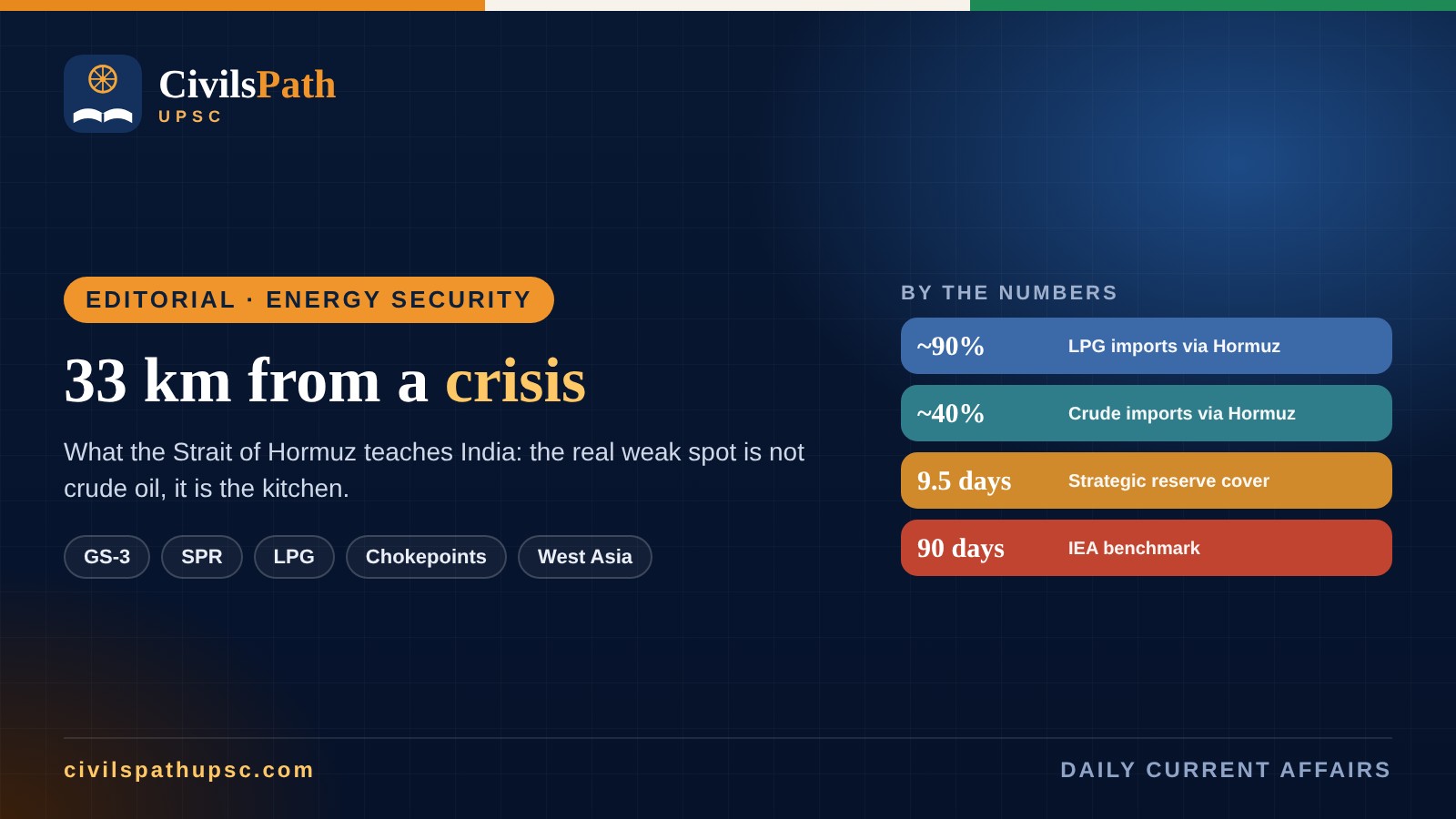
India imports about 90% of the crude oil it refines and about half of its natural gas; overall, about 40% of its total energy is imported (IEA). It consumes about 5.5 million barrels of oil a day. The exposure to Hormuz differs sharply by fuel:
Crude is the most talked-about, but it is not the most exposed. Since 2022, India has spread its crude purchases across about 40 countries, with Russia the largest supplier. The real weak spot is the kitchen.
| Supplier | Share of India's crude imports by value (Apr–Jan, FY26) | Route |
|---|---|---|
| Russia | 30.4% | Baltic / Black Sea / Pacific: no Hormuz |
| Iraq | 17.8% | Basra: through Hormuz |
| Saudi Arabia | 14.2% | Mostly Gulf ports; part can go via Yanbu |
| UAE | 11.4% | Part via Fujairah: can avoid Hormuz |
| USA | 7.7% | Atlantic / Gulf of Mexico: no Hormuz |
3. The kitchen is the frontline
India meets only about 40% of its LPG demand from domestic production; the rest is imported, overwhelmingly from the Gulf. The IEA estimates that LPG passing through Hormuz fills about half of India's household cooking cylinders, and that India's LPG imports fell by more than half in the first two months of this year's conflict. That is why the March 2026 response focused on cylinders: refiners were told to raise LPG output (by about 1.8 lakh barrels a day), the gap between bookings was stretched from 21 to 25 days, LPG carriers got priority berthing, and ₹30,000 crore was approved to cover under-recoveries.
4. How big is the cushion?
India's Strategic Petroleum Reserves (SPR), run by Indian Strategic Petroleum Reserves Ltd (ISPRL), are underground rock caverns at Visakhapatnam (1.33 MMT), Mangaluru (1.5 MMT) and Padur (2.5 MMT), a total of 5.33 million tonnes. In March 2026 the government told Parliament they were about 64% full, and an RTI reply put their cover at about 9.5 days of crude requirement. Oil companies hold more in tanks and refineries, but the strategic buffer itself is thin.
| Planned expansion | Status (2026) |
|---|---|
| Chandikhol, Odisha: 4 MMT (Phase II) | Land partly acquired; bidding document under review |
| Padur II, Karnataka: 2.5 MMT (Phase II) | Concession signed 1 Oct 2025; financial closure in progress |
| Bina (MP) and Bikaner (Rajasthan) | Feasibility studies |
| ONGC storage at Mangaluru | Half to be kept as a strategic reserve |
5. What the crisis revealed
Diversification works, but only for crude: buying from Russia, the US, West Africa and Latin America limited the damage. Gas and LPG remain concentrated in the Gulf.
Policy is reactive: control orders, booking limits and subsidies are crisis tools. The SPR Phase II, approved in 2021, is still not built.
Refinery choices matter: private refineries yield far less LPG than public ones, and LPG earns less per barrel than diesel or petrol. Without incentives, the market will not produce more LPG on its own.
Seafarers are part of energy security: in March 2026, 28 Indian-flagged ships with 778 seafarers were inside the Gulf. Naval escort and evacuation planning are now part of the energy story.
6. The deeper fix: a five-part agenda
| Lever | What to do | Trade-off |
|---|---|---|
| Store more | Finish Phase II; use commercial-cum-strategic storage; lease tanks abroad (Fujairah, Oman) | Costly to fill when prices are high |
| Route around | Prefer cargoes from Yanbu and Fujairah; long-term deals with non-Gulf suppliers | Higher freight; sanctions risk on some suppliers |
| Cook differently | Expand piped gas (already in over 1.7 crore homes) and electric cooking in cities, keep LPG for rural poor | Needs grid and city gas investment |
| Make more at home | Incentives for LPG yield, more domestic gas, biogas (SATAT) and ethanol blending | Lower refinery margins; food–fuel debate |
| Use less oil | EVs for buses and two-wheelers, rail freight, green hydrogen for industry | Long time horizon; new import dependencies (batteries) |
The goal is not to cut off the Gulf. Gulf suppliers are reliable partners and India's diaspora lives there. The goal is to make sure that when the strait closes, India loses money, not cooking gas.
7. Verdict
Energy security used to mean having enough oil. After 2026, it means having options: more routes, more storage, more fuels and fewer single points of failure. India has done well on crude diversification. It now needs the same seriousness for LPG and LNG, and a strategic reserve measured in weeks, not days.
Where this fits in the syllabus
| Use it in | How |
|---|---|
| GS-3: Energy, infrastructure | SPR, LPG import dependence, city gas, ethanol blending, EVs |
| GS-2: International relations | West Asia conflict, Gulf partnerships, chokepoint diplomacy, naval diplomacy |
| GS-3: Security | Maritime security, Operation Sankalp-type escort missions, seafarer safety |
| Essay | 'Energy security is national security' · 'Resilience is built before the crisis' |
Facts to remember for Prelims
Strait of Hormuz: Connects the Persian Gulf with the Gulf of Oman; Iran to the north, Oman's Musandam to the south.
Hormuz bypass pipelines: Saudi East–West pipeline to Yanbu on the Red Sea, and UAE's Habshan–Fujairah pipeline.
ISPRL: Set up in 2004 to build India's Strategic Petroleum Reserves.
Phase I SPR sites: Visakhapatnam, Mangaluru and Padur, total 5.33 million tonnes.
Phase II SPR sites: Chandikhol in Odisha and Padur II in Karnataka, total 6.5 million tonnes.
IEA 90-day rule: Members must hold oil stocks equal to 90 days of net imports; India is an association country.
Import dependence: About 90 percent of crude oil and about half of natural gas, as per the IEA.
Mains practice
Keywords: chokepoint · strategic reserve · days of cover · supplier diversification · route diversification · LPG yield · city gas distribution · demand-side resilience.
Also read: The Hindu analysis, 26 November 2026 (Hormuz mines) · Places in News map
Sources: India Briefing: Hormuz and India's oil supply · Business Today: IEA on India's LPG imports (20 Nov 2026) · Business Today: SPR covers under 10 days (Mar 2026) · Business Today: New SPR sites at Bina and Bikaner · IMPRI: India's response to the Hormuz crisis · S&P Global: India weighs alternate crudes
A CivilsPath editorial analysis based on government statements, IEA findings and news reports cited below. Figures on the share of imports through Hormuz vary by source and month; we use rounded ranges. This is analysis for exam preparation, not investment advice.