Why IAS officers marry IAS officers and doctors marry doctors: homogamy, caste and the new inequality, explained for UPSC
Scroll through any list of recent civil services weddings and a pattern jumps out. An IAS officer marries an IAS officer. A doctor marries a doctor. An IIT graduate marries an IIT graduate. We call these love stories, and many of them are. But sociologists have a sharper name for the pattern, and it is one of the most useful ideas you can carry into GS-1, the Essay paper and Sociology optional.
The idea in one line
Homogamy is the tendency of people to marry people who are like them: in caste, religion, education, occupation, income or social status. Economists describe the same thing as assortative mating, a term borrowed from biology. When 'like marries like', it is positive assortative mating; when opposites marry, it is negative assortative mating (heterogamy).
| Term | Meaning | Indian example |
|---|---|---|
| Homogamy | Marrying someone of similar social position | Two IAS officers, two doctors |
| Assortative mating | Economists' term for non-random matching of partners | Engineer-engineer couples in IT cities |
| Endogamy | Rule to marry inside one's own group | Marriage within the same caste or sub-caste |
| Exogamy | Rule to marry outside a group | Marrying outside one's gotra or village |
| Hypergamy | Woman marrying a man of higher status | Anuloma in classical texts |
| Hypogamy | Woman marrying a man of lower status | Pratiloma, traditionally disapproved |
Step 1: You can only fall in love with the people you meet
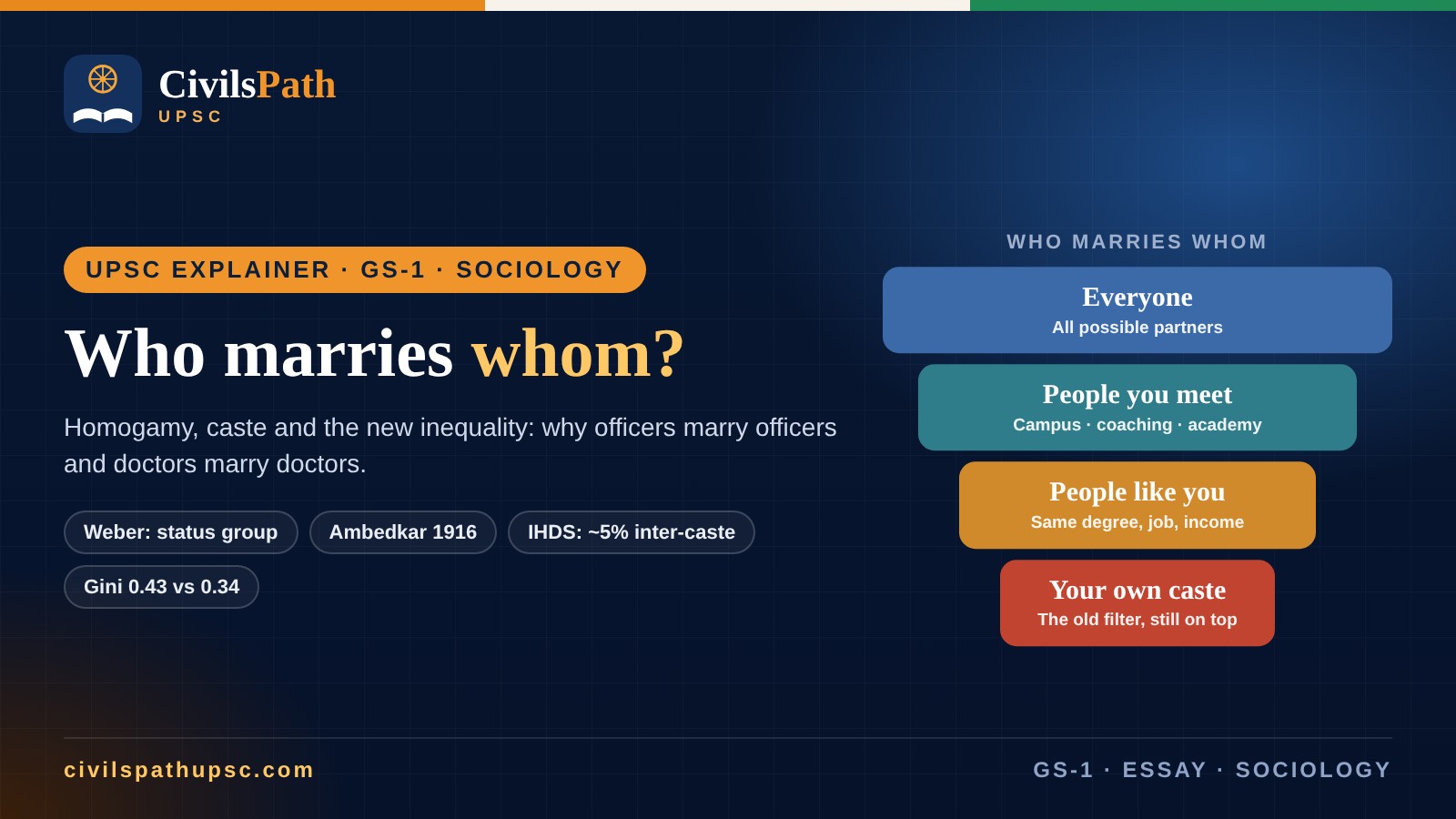
'Isn't it just that they fell in love?' Yes. But love does not happen in a vacuum. Sociologists call this propinquity: we choose from the people around us. A doctor spends a decade in medical college, hostels and hospital wards. A civil servant spends years in coaching classes, libraries, the Foundation Course at LBSNAA and then the service itself. The pool from which you choose is the room you sit in.
So the first filter is not taste but opportunity. Institutions, cities and professions quietly sort people long before anyone thinks of marriage.
All possible partners
Campus, coaching, office, academy
Same degree, job, income, values
The old filter, still on top
Step 2: Then comes a shared life
Night duties, transfers, long hours and the pressure of the job are easier with a partner who understands them without an explanation. Economist Gary Becker's 'A Theory of Marriage' (1973) argued that couples gain when their traits complement or match, and that a marriage market tends to pair similar partners.
Even the State plans for it. Under the All India Services cadre rules and DoPT's cadre policy, an AIS officer who marries another AIS officer may seek a change of cadre so that both can serve in the same State. DoPT guidelines also ask departments to post husband and wife in government service at the same station as far as possible. Policy, in other words, accepts that two-career couples are now normal.
Step 3: The deeper reason, Max Weber's status groups
Max Weber said society is ranked not only by money, which he called class, but also by honour and prestige, which he called status. People who share a status form a status group. Status groups guard their position in two classic ways: whom they eat with (commensality) and whom they marry (connubium).
Weber went further. When a status group closes itself completely and makes its boundaries hereditary, it can harden into a caste. Read that sentence again with India in mind.
Step 4: Ambedkar had already said it, in 1916
On 9 May 1916, a 25-year-old B.R. Ambedkar read a paper titled 'Castes in India: Their Mechanism, Genesis and Development' at an anthropology seminar at Columbia University. His central claim was striking: endogamy, the absence of intermarriage, is the only characteristic that is peculiar to caste.
Ambedkar argued that caste was created by superimposing endogamy on exogamy. Groups that married outside the clan (gotra) but strictly inside the larger group closed themselves off. He even read practices such as child marriage and the treatment of widows as devices to keep the group's marriage boundary intact. Weber described the process from outside; Ambedkar explained it from inside.
Step 5: The old rule is still alive
The India Human Development Survey (IHDS), run by NCAER and the University of Maryland, found that only about 5 per cent of Indian marriages are inter-caste. The figure barely moves between cities and villages, or between richer and poorer households.
So when a doctor marries a doctor, the new filter of profession usually sits on top of the old filter of caste. It is added to caste, not used instead of it. Matrimonial columns that ask for 'IAS/IPS/doctor only' often name the caste in the same line. This is the key analytical point for your answers: modern homogamy (by degree and job) layers over traditional endogamy (by caste) rather than replacing it.
Why it matters: the inequality machine
When the educated marry the educated, advantages pile up inside one household: two high incomes, two professional networks, better schools, coaching, English, books at home and confident career advice. These pass to the children. Bourdieu called this cultural capital.
Economists Jeremy Greenwood and co-authors studied US data in 2014 ('Marry Your Like'). Household income inequality in 2005 was a Gini of 0.43. If couples had been matched at random, it would have been 0.34. Who marries whom, by itself, made a visible difference to inequality.
In India, the effect is doubled. Caste endogamy keeps social capital inside the community, and educational homogamy keeps economic capital inside the class. The result is a narrow elite that reproduces itself: in the old form through caste, and in the new form through degree and service.
The other side: is this really a problem?
Fairness demands the counter-argument. Marriage is a deeply personal choice, protected by the Constitution. Shared values, similar work hours and mutual understanding make many such marriages happier and more equal. Rising education among women means more couples are equals, and studies across many countries show that the old pattern of women 'marrying up' is weakening.
Homogamy by education is also more open than caste: anyone can, in principle, earn a degree or clear an exam, but no one can change the caste they were born into. The concern is not with any individual couple. It is with what millions of such choices, added together, do to mobility and fairness.
What the State and the courts have done
| Measure | What it does |
|---|---|
| Special Marriage Act, 1954 | Civil marriage across caste and religion, with a 30-day public notice |
| Dr. Ambedkar Scheme for Social Integration through Inter-Caste Marriages | Incentive of ₹2.5 lakh where one spouse is from a Scheduled Caste; run by the Dr. Ambedkar Foundation |
| Lata Singh v. State of U.P. (2006) | Supreme Court: adults are free to marry across caste; harassment must be stopped |
| Shakti Vahini v. Union of India (2018) | Khap interference and honour crimes are illegal; preventive, remedial and punitive steps ordered |
| Shafin Jahan v. Asokan K.M. (2018) | Right to choose a partner is part of Article 21 |
Fixes that can work
Create mixing spaces: common schools, hostels, NSS and NCC, sports and exchange programmes where young people from different backgrounds meet as equals.
Protect choice: safe houses and fast police protection for inter-caste and inter-faith couples, as the Supreme Court directed.
Weaken inherited advantage: better public schools and colleges reduce how much a child's future depends on whom the parents married.
Shift norms: public figures, films and families that celebrate inter-caste marriage change what feels 'normal' faster than any law.
Prelims facts at a glance
Homogamy: Marriage between people of similar social position, such as caste, education, occupation or status.
Assortative mating: Economists' term for non-random pairing of partners with similar traits.
Endogamy: Rule of marrying within one's own group, such as caste or sub-caste.
Exogamy: Rule of marrying outside a group, such as one's gotra or clan.
Anuloma: Marriage of a man of higher varna with a woman of lower varna (hypergamy).
Pratiloma: Marriage of a woman of higher varna with a man of lower varna (hypogamy).
Castes in India (1916): Paper by B.R. Ambedkar at Columbia University; endogamy is the essence of caste.
Max Weber: Three dimensions of stratification are class, status and party.
Connubium: Weber's term for restricting marriage to members of the same status group.
A Theory of Marriage (1973): Work by economist Gary Becker on the marriage market.
IHDS: India Human Development Survey by NCAER and the University of Maryland; about 5% inter-caste marriages.
Special Marriage Act: Enacted in 1954; civil marriage with 30 days' notice.
Ambedkar inter-caste marriage scheme: ₹2.5 lakh incentive when one spouse is from a Scheduled Caste.
Shafin Jahan case (2018): Right to choose a life partner is part of Article 21.
Shakti Vahini case (2018): Supreme Court guidelines against honour crimes and khap interference.
Mains practice
Keywords for your answer
Homogamy · assortative mating · status group · connubium · endogamy · exogamy · hypergamy · cultural capital · elite closure · intergenerational transmission of advantage · social mobility.
Use this in GS-1 (Indian society, caste, marriage and family, social change), in Sociology optional under stratification and kinship, and in Essay topics on love, equality and modern India. The deeper lesson: what looks like a private choice is also how a society quietly reproduces its inequality.
Also read: The Hindu analysis, 23 November 2026 · Free UPSC study tools
Sources: B.R. Ambedkar, 'Castes in India' (1916); Max Weber, 'Economy and Society'; Gary Becker, 'A Theory of Marriage' (1973). IHDS, NCAER and University of Maryland · Greenwood et al. (2014), 'Marry Your Like', American Economic Review · Special Marriage Act, 1954 (India Code)
This explainer is written by CivilsPath for UPSC preparation from published research, court judgments and official schemes. Figures are from the studies named; check the original sources for exact methods and later data.