Chhath Puja: what it is, what it is not, and a 225-year-old painting from Patna
Today, millions of people stand knee-deep in rivers, ponds and temporary pools at sunset, holding bamboo baskets of fruit and lamps, and offer their thanks to the sun. This is Chhath Puja, one of the most distinctive festivals of eastern India. For a UPSC aspirant it is more than a festival: it is a living example of folk tradition, ecology, society and even art history. Let us look at what it is, what we really know about it and what we do not.
What is Chhath?
Chhath is a four-day festival dedicated to the Sun and observed on the sixth day (Shashthi) of the waxing fortnight of the month of Kartik, a few days after Diwali. It is celebrated most widely in Bihar, Jharkhand, eastern Uttar Pradesh and the Terai region of Nepal, and wherever people from these regions have settled. Alongside Surya, devotees also remember Chhathi Maiya, a deity associated with the sixth day.
The four days
On the first day, Nahay Khay, devotees bathe in a river or pond and eat a simple meal. On the second day, Kharna, they fast through the day and break the fast with kheer and rotis in the evening, after which a fast of about 36 hours without water begins. On the third day, the evening arghya (Sandhya Arghya), families gather at the water's edge and offer fruits, thekua and lamps to the setting sun. On the fourth day, at dawn, they offer arghya to the rising sun and then break the fast.
What we know and what we do not
Popular belief links Chhath to old stories: that Sita and Rama observed a sun worship after returning to Ayodhya, that Draupadi fasted to the sun, and that Karna worshipped Surya. These are traditional accounts, not independently verified history. Sun worship itself is very old in the Indian tradition, with sun hymns in the Vedic literature, but historians do not agree on a single date or place of origin for Chhath in its present form. The honest answer is that it is an ancient, evolving folk practice with no single founding moment.
What Chhath is not
It is not a festival that depends on idols, temples or priests: the devotee stands directly before the rising or setting sun. It is not limited to one caste or class, and the offerings are made with simple, seasonal, local things: bamboo baskets, earthen lamps, sugarcane, bananas, radish and the sweet thekua. It is also not only for women: most of those who observe the fast are women, but men observe it too. And it is not a festival with a fixed scientific claim. You will see many social media posts about health benefits of sun exposure; they are popular, but they are not settled science and should not replace medical advice, especially for a 36-hour fast.
Why it matters for a UPSC aspirant
In General Studies Paper I, Chhath fits under Indian culture and society: regional festivals, folk traditions and the way tradition holds communities together. It is a good example for the essay paper on themes like tradition and modernity, or the role of women in preserving culture. It also offers lessons for governance: crowd management at ghats, clean rivers, safe water, temporary infrastructure and administrative coordination in states are real tasks that officers manage every year.
A 225-year-old painting from Patna
A post on social media this week highlighted a painting about 225 years old, kept in the British Library, said to show Chhath at a Ganga ghat in Patna. We checked the British Library's archive catalogue. It lists a set of eight watercolour drawings of Hindu and Muslim festivals and ways of life, shelfmark Add Or 937-944, made by Patna artists around 1795 to 1800, and purchased by the library in 1959. The catalogue suggests the set was probably made for Ephraim Pote, who was the Commercial Resident at Patna from 1787 to 1800.
One item in the set, Add Or 940, is described as a "Chait festival, on the banks of the Ganges at Patna". The catalogue entry we saw does not call it Chhath. Since a Chhath is also observed in the month of Chaitra (called Chaiti Chhath), it is plausible that this is the painting people are talking about, but we cannot confirm that identification from the catalogue alone. If you are citing it, say that it is described as a festival on the Ganga at Patna, around 1795 to 1800, and often connected to Chhath in popular posts.
The art-history angle
These works belong to what is called Company painting or the Patna Qalam (Patna school). Artists, some of whom had come from Murshidabad in Bengal, settled in Patna and blended Indian miniature traditions with the realism and subdued colours that their British patrons liked. They painted ordinary occupations, festivals, processions, birds and the ghats of Patna. This style declined after photography arrived. It is a useful topic for the Art and Culture section, and the painting shows that river-bank festivals were already part of life at Patna's ghats two centuries ago.
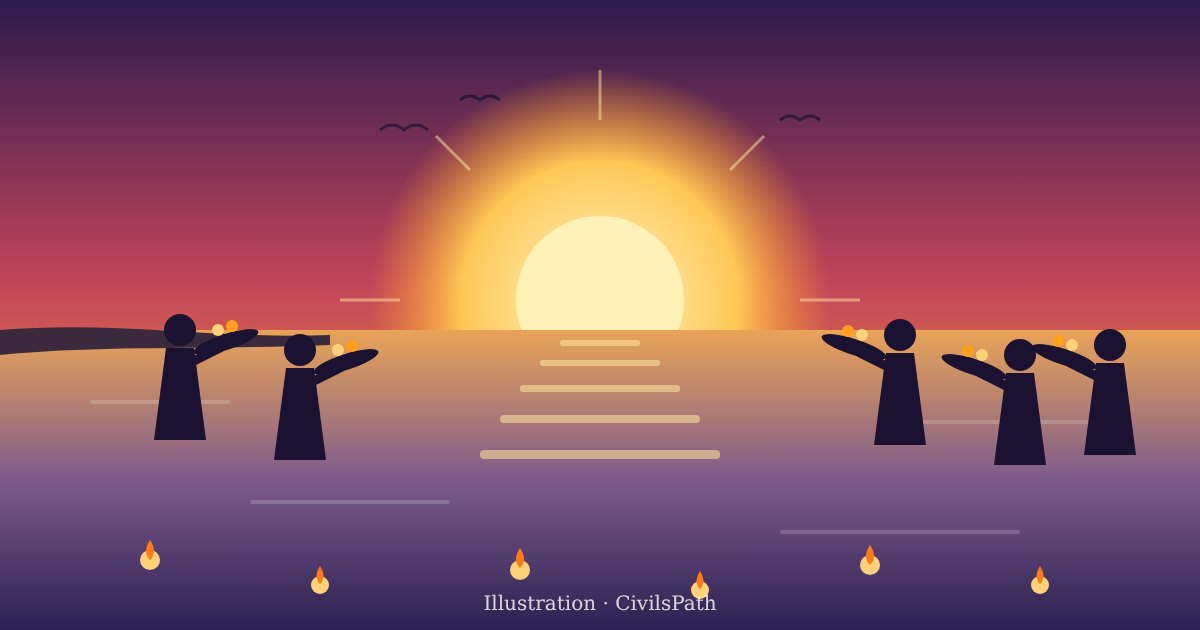
The image above is our own illustration for this story. We have not reproduced the British Library painting, which is held by that institution.
Chhath Puja ki hardik shubhkamnayein
To everyone observing the fast today, we wish you strength, health and a peaceful arghya at sunset and sunrise. To those who are away from home and missing the ghat, the thekua and the songs, may the festival reach you wherever you are. And to every aspirant reading this: like the sun at dawn, your day will come. Happy Chhath Puja from all of us at CivilsPath. 🙏🌅
This story is written in our own words and is based on publicly available information on the internet. Please check official and archive sources for exact details.
This profile is written in our own words from publicly reported information. Details such as attempt numbers and marks can differ between sources, so please check the official UPSC results for exact figures.