A 150-gram bird flew 5,700 km non-stop over the sea: the incredible Amur falcon story from Manipur to Somalia
She weighs about as much as a mobile phone. She left a village in Manipur's Tamenglong district, flew out over the Arabian Sea, and did not land for 101 hours. When she finally touched down in Somalia, she had covered about 5,700 km. Her name is Alang, a young Amur falcon, and scientists from the Wildlife Institute of India (WII) tracked every kilometre by satellite. It is one of the most beautiful science stories of the year, and a perfect Prelims topic.
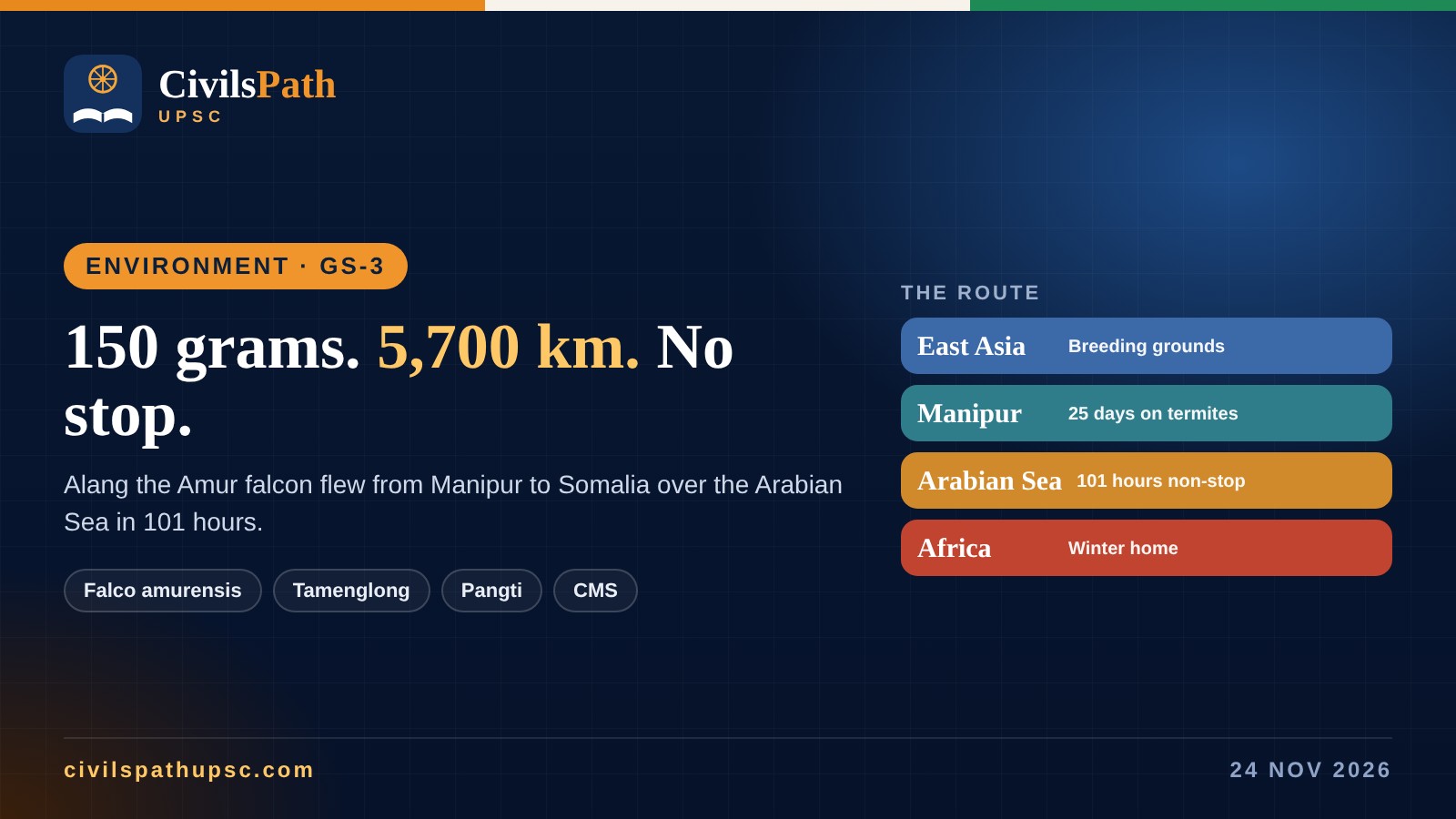
The record flight
WII scientists fit satellite tags on three Amur falcons in Manipur: Apapang (adult male), Alang (young female) and Ahu (adult female).
The birds winter in Africa, fly back to breeding grounds in East Asia and return to Manipur in October 2026, after more than 20,000 km across 23 countries.
About 25 days in Tamenglong feasting on winged termites to build fat reserves.
Alang flies about 5,700 km non-stop to Somalia in 101 hours. Apapang had covered about 4,100 km in 95 hours and was over the Arabian Sea at his last signal on 21 November.
Meet the Amur falcon
| Feature | Detail |
|---|---|
| Scientific name | Falco amurensis |
| Weight | About 100 to 180 grams; females are larger |
| Breeds in | South-east Russia, north-east China and Mongolia |
| Winters in | Southern and eastern Africa |
| Stopover in India | Nagaland, Manipur and nearby North-East, mid-October to early November |
| Migration | Over 20,000 km a year, the longest of any bird of prey |
| IUCN status | Least Concern |
How does a tiny bird cross an ocean without stopping?
Fuel: weeks of eating termites in the North-East give the bird a store of fat, its 'jet fuel'.
Wind: in November the north-east monsoon winds blow across the Arabian Sea from the north-east, giving a tailwind towards Africa. A 2026 study in the journal Ibis linked the falcons' routes and flight efficiency to wind patterns.
No choice: falcons cannot rest on water. Once they leave the coast, they must keep flying until they reach land.
From hunting ground to 'Falcon Capital': a conservation turnaround
In October 2012, mass trapping was uncovered near the Doyang reservoir in Nagaland, where more than a lakh falcons were caught for meat in a few weeks. The images shocked the world. What followed is a model of community conservation: the State, NGOs, journalists, scientists and village councils worked together. Hunters became protectors, and Pangti village in Wokha district became known as the 'Falcon Capital of the World'. Today schoolchildren sing songs to welcome the birds, and Tamenglong villages in Manipur guard their roosts.
Why UPSC loves this story
It joins geography (monsoon winds, Arabian Sea), environment (migration, flyways, CMS), society (tribal communities, livelihoods) and governance (a crisis turned into a success). Use it as an example in GS-3 answers on biodiversity, and in Essay or Ethics answers on how people change when they are involved, not just policed.
Facts to remember for Prelims
Amur falcon: Falco amurensis, a small raptor of about 150 grams with the longest migration of any bird of prey.
Alang: Young female Amur falcon that flew about 5,700 km non-stop from Manipur to Somalia in 101 hours in November 2026.
Apapang: Adult male Amur falcon tagged in Manipur; covered about 4,100 km in 95 hours over the Arabian Sea.
Tamenglong: District in Manipur where the Amur falcons were tagged and roost.
Pangti village: In Wokha district, Nagaland; known as the Falcon Capital of the World.
Doyang reservoir: Nagaland site where mass trapping of Amur falcons was exposed in 2012.
Amur falcon IUCN status: Least Concern.
CMS COP13: Held at Gandhinagar, India, in 2020.
North-east monsoon: Winds blowing from the north-east in winter, aiding the falcons' sea crossing.
Mains practice
Also read: Places in News map · Revision flashcards
Sources: Khaleej Times: Hasina's planned return · Outlook: India says courts will decide · ThePrint: Can India extradite Hasina · Outlook: Paschim Banga proposal · Onmanorama: Keralam assent · ThePrint: Amur falcons' migration · Dawan Africa: Amur falcon 5,700 km
Based on public reports and official statements available on 24 November 2026. CivilsPath takes no political side; positions of each side are reported as stated. Check later news for developments.